#MotorTalkMonday – How Power Quality Impacts Your Motor
When an electric motor experiences recurring problems, the motor itself is often the first place maintenance teams look. Bearings, lubrication, alignment, loading, and operating conditions are all important factors to consider.
However, sometimes the problem starts before the power ever reaches the motor.
Power quality can affect the performance, reliability, and life of electrical equipment, including motors. Understanding common power disturbances can help maintenance teams look beyond the motor when troubleshooting recurring problems.
What Is Power Quality?
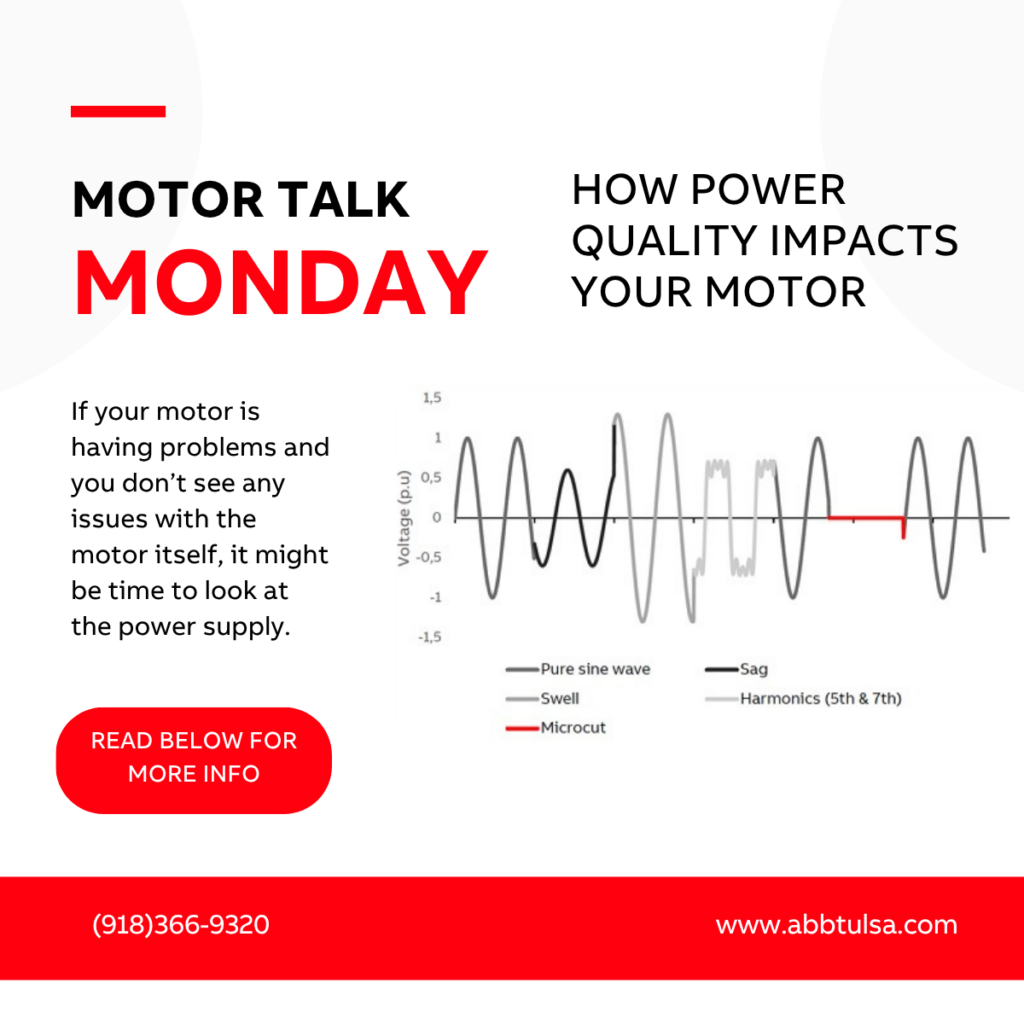
Ideally, an AC electrical supply follows a consistent sinusoidal waveform. In real-world electrical systems, however, that supply can experience disturbances.
ABB identifies several common power quality challenges, including voltage sags and swells, harmonic distortion, microcuts and outages, spikes and transients, under- and overvoltage, voltage fluctuations, frequency variations, and poor power factor.
These disturbances don’t all affect equipment in exactly the same way. However, they can create problems throughout an electrical system.
How Can Power Quality Affect a Motor?
For electric motors, one of the primary concerns associated with poor power quality is additional heat.
Harmonic distortion, for example, can increase losses in a motor and contribute to overheating. ABB also notes that power quality issues can contribute to mechanical stress and shortened equipment life. Elsewhere in the electrical system, poor power quality can contribute to unwanted tripping, equipment malfunction, and process interruptions.
Some problems can also be difficult to recognize immediately. The motor may continue to operate even while electrical conditions are creating additional stress.
Look Beyond the Motor
When troubleshooting a recurring motor problem, it’s important to consider the complete system.
If a motor repeatedly overheats, protective devices trip unexpectedly, or equipment experiences unexplained reliability issues, repairing or replacing the motor may not address the underlying cause.
Instead, it may be worth evaluating the electrical supply and determining whether power quality problems are contributing to the issue.
A motor doesn’t operate independently from the electrical system around it. Sometimes, solving a motor problem means looking beyond the motor and taking a closer look at the power feeding it.