#MotorTalkMonday – How Many Starts Is Too Many?
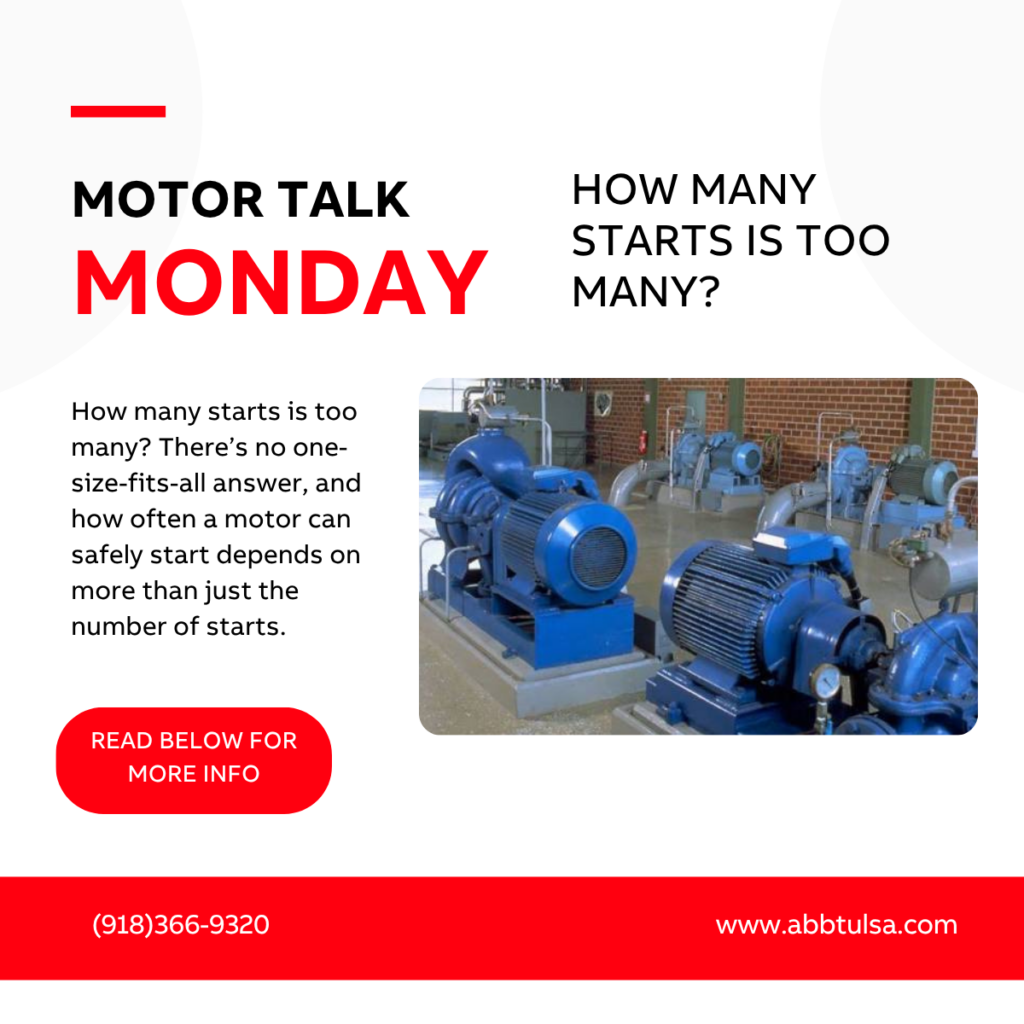
How many times can you safely start an electric motor in an hour?
The answer isn’t as simple as giving one number. There is no universal starts-per-hour limit that applies to every motor.
Motor design, load characteristics, acceleration time, starting method, operating temperature, and time between starts can all affect how frequently a motor can safely be started.
Understanding why starts matter can help prevent excessive thermal stress and ensure the motor is properly matched to the application.
Why Does Starting Frequency Matter?
As we discussed in our previous Motor Talk Monday on what happens during a motor start, starting is very different from normal running operation.
When an induction motor starts across the line, it can draw several times its normal full-load current. As the motor accelerates, current decreases toward its normal operating level.
That high-current period generates additional heat within the motor.
One start isn’t necessarily a problem. However, repeated starts can become an issue when the motor doesn’t have enough time to dissipate the heat generated by one start before the next begins.
Over time, excessive starting can subject the motor’s windings and insulation system to additional thermal stress.
It’s Not Just the Number of Starts
Two motors that start the same number of times per hour may experience very different conditions.
That’s because how difficult each start is matters just as much as how often it happens.
Several factors affect starting duty.
Load Inertia
Inertia describes an object’s resistance to a change in speed. A load with high inertia requires more energy and generally more time to accelerate.
The longer the motor takes to bring the load up to speed, the longer it can remain at elevated current.
That means a motor starting an easy-to-accelerate load may experience very different thermal conditions than the same motor starting a high-inertia load.
Acceleration Time
Closely related to inertia is acceleration time.
A motor that reaches operating speed quickly spends less time in the starting condition. If acceleration takes longer, the motor remains at elevated current for a longer period and generates additional heat.
For this reason, acceleration time is an important consideration when evaluating starting frequency.
Hot Starts vs. Cold Starts
The motor’s temperature before a start also matters.
A motor beginning from a cold condition has more thermal capacity available than one that has already been operating under load. After the motor has been running, or after several recent starts, its internal temperature may already be elevated.
Another immediate start adds heat before the motor has had an opportunity to cool.
Therefore, allowable starting conditions may differ depending on whether the motor is starting cold or is already warm.
Motor Design
Starting characteristics also vary from motor to motor.
Motor horsepower, speed, design, rotor inertia, enclosure, thermal characteristics, and other factors can influence how a motor responds to repeated starts.
ABB Baldor-Reliance motor performance data, for example, provides information such as starting current, locked-rotor torque, full-load current, and rotor inertia for individual motor designs. These characteristics can vary considerably between motors.
That’s another reason a single starts-per-hour recommendation shouldn’t be applied to every motor.
Starting Method
How the motor is started can also affect the starting event.
Across-the-line starting applies full line voltage to the motor, while other starting methods may change current, torque, or acceleration characteristics.
The entire motor-and-load system should be considered when determining whether an application requires frequent starting.
So, How Many Starts Are Too Many?
Unfortunately, there’s no magic number.
An acceptable number of starts for one motor and application may be excessive for another. Rather than relying on a general starts-per-hour rule, consider:
- The specific motor’s starting capabilities
- The inertia of the motor and driven load
- Required starting torque
- Acceleration time
- Starting method
- Motor temperature before restarting
- Time available between starts
- The application’s overall duty cycle
For applications that require frequent starting, the motor should be selected and applied with that duty in mind.
Don’t Assume One More Start Won’t Matter
Starting is a normal part of motor operation, but every start adds thermal stress.
In an application that starts only occasionally, that may never become a concern. In applications that cycle frequently, however, starting duty becomes an important part of motor selection.
If you’re unsure whether a motor can handle the required starting frequency, check the manufacturer’s recommendations for the specific motor and application.
When it comes to motor starts, how often matters, but what happens during each start matters just as much.