#MotorTalkMonday – why small motors offer big efficiency gains
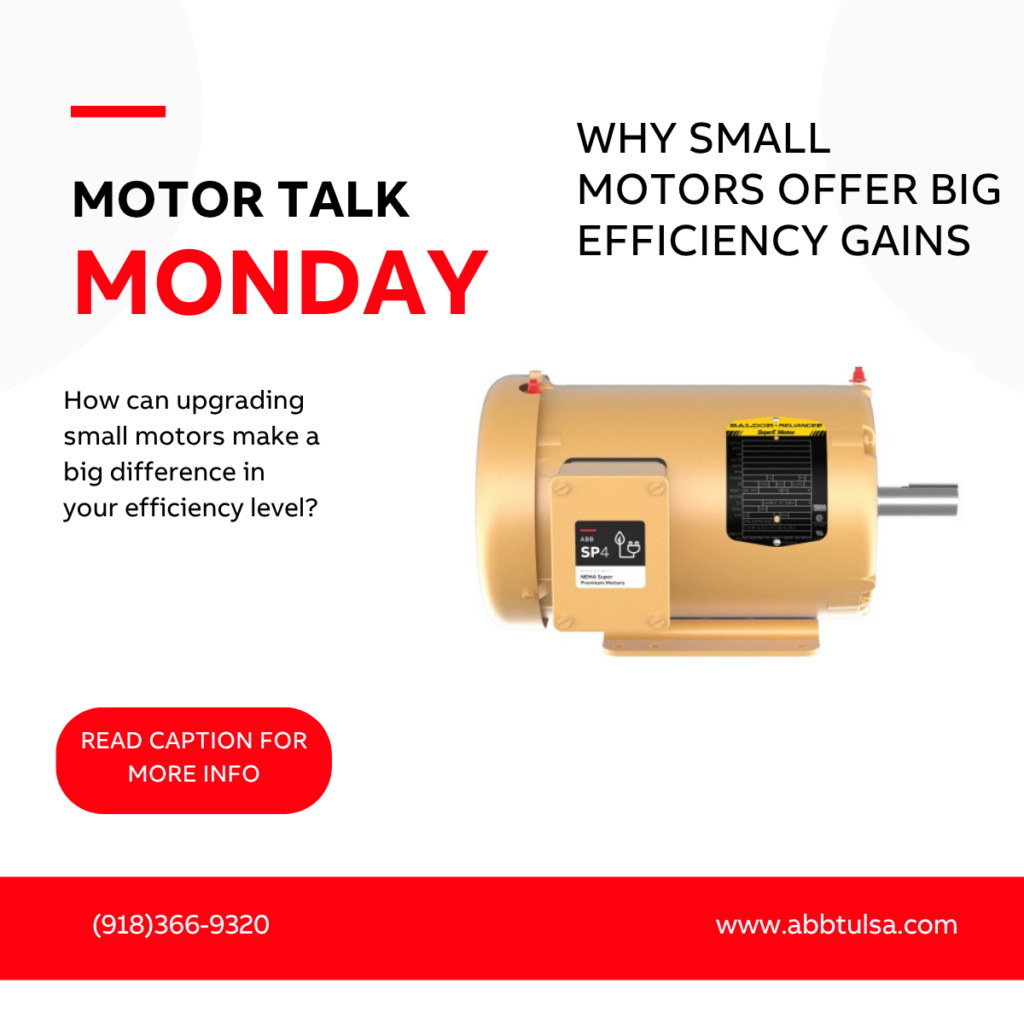
When facilities discuss motor efficiency upgrades, the conversation usually centers around large horsepower motors. While those motors certainly matter, many plants overlook a surprisingly impactful opportunity: smaller motors in the 1–3 HP range.
These motors are everywhere. They power fans, pumps, compressors, conveyors, and countless auxiliary systems throughout industrial facilities. Because each individual motor is relatively small, they are often ignored during energy and reliability discussions.
However, that can be a costly mistake.
Small Motors Add Up Quickly
A single small motor may not consume a large amount of power on its own. The challenge is that most facilities operate dozens, or even hundreds, of them continuously.
Over time, those energy costs add up.
In many cases, the efficiency improvement between a standard efficiency motor and a premium efficiency motor is proportionally larger on small motors than on larger horsepower units. That means upgrading a small motor can deliver a noticeable improvement in operating cost, especially in applications that run around the clock.
For motors that operate continuously, even small efficiency gains can create measurable annual savings.
Energy Savings Are Only Part of the Story
The discussion around premium efficiency motors often focuses on power consumption. However, reliability can be just as important.
Premium efficiency motors typically run cooler than standard efficiency motors. Lower operating temperatures can help:
- Extend bearing life
- Reduce insulation breakdown
- Lower thermal stress on components
- Improve overall motor lifespan
- Reduce the risk of unexpected downtime
In industrial environments, reliability improvements can easily outweigh the direct energy savings.
The Best Time to Upgrade
One of the most practical times to move to premium efficiency is during a motor replacement.
When a small motor fails, many facilities automatically choose the lowest-cost replacement or send the motor out for rewind. However, the price difference between a standard efficiency motor and a premium efficiency motor is often relatively small compared to the total cost of downtime, labor, and installation.
That is why point-of-failure replacement can provide a strong return on investment.
Instead of simply restoring operation, the facility also gains a more efficient and reliable motor moving forward.
Don’t Ignore the Small Motors
Large motors deserve attention, but smaller motors should not be overlooked. The combined energy consumption and maintenance impact of multiple small motors can quietly affect a facility’s operating costs for years.
Taking a closer look at continuously operating small motors may reveal simple upgrade opportunities that improve both efficiency and reliability.
What small motor applications in your facility run nonstop?