
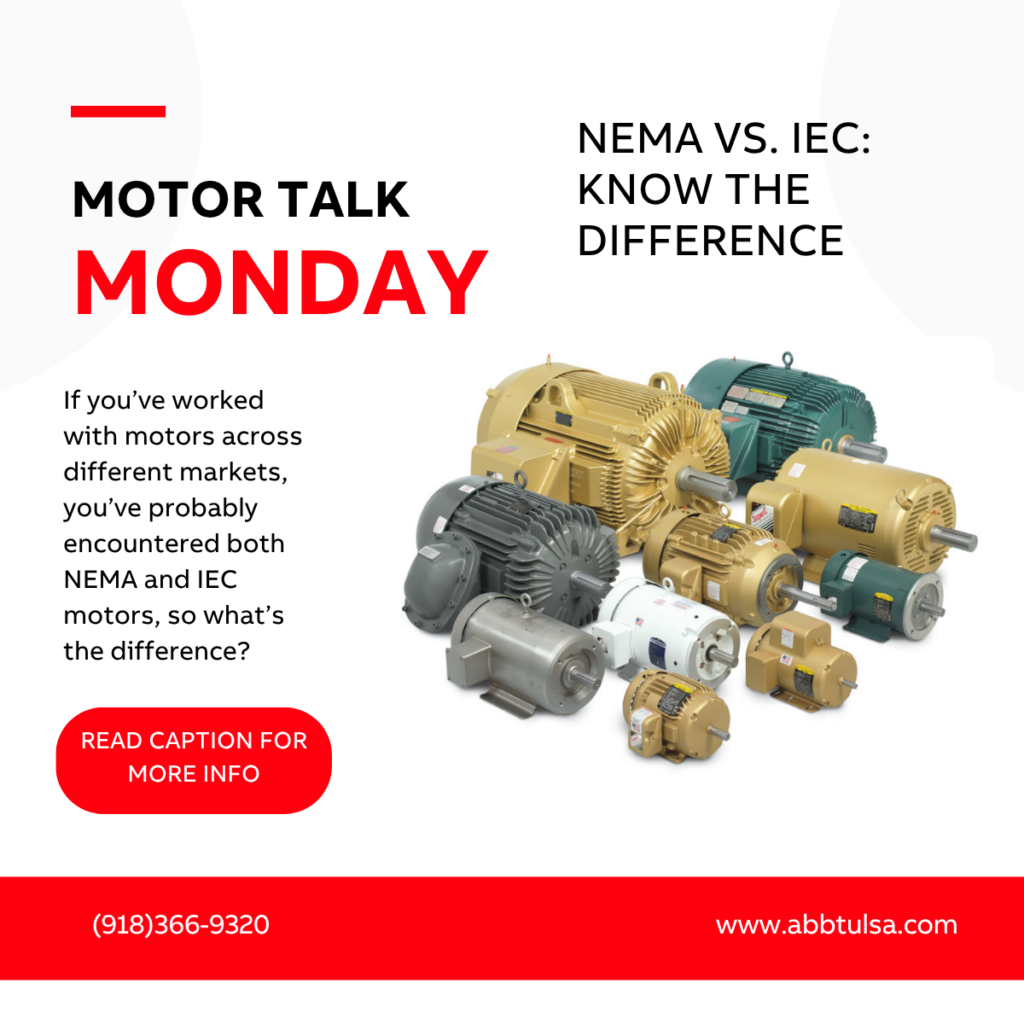
#MotorTalkMonday – NEMA vs. IEC: know the difference
Electric motors operate under strict standards, but not all standards are the same. If you manage facilities across different regions or work with equipment from various manufacturers, you’ve likely encountered two major classifications: NEMA (North American Electric Manufacturers Association) and IEC (International Electrotechnical Commission).
They’re not just different naming systems. They represent distinct design philosophies. Confusion between them can lead to costly downtime, incompatible replacements, and procurement delays.
Here’s what you need to know.
The Mechanical Differences
The most immediate, practical difference is frame sizes. NEMA and IEC use completely different frame designation systems. NEMA frame sizes use four or five digits (143T, 254T, 326T) based on shaft height and bolt patterns. IEC frame sizes use letter-number combinations (100L, 160M, 180L) based on mounting flange diameter.
A NEMA 254T motor will not physically replace an IEC 180M motor, even if both are rated around 25 horsepower. The shaft height, bolt patterns, and physical dimensions are all different. Ordering the wrong standard means redesigning mounting brackets, realigning equipment, or facing extended downtime.
Beyond frame sizes, NEMA motors offer a wider range of enclosures, such as open-drip proof (ODP) designs used in many compressor and fan applications. IEC motors are typically available in more limited enclosure options. Additionally, NEMA motors commonly use polyurea-based grease, while most IEC motors use lithium grease. These greases are not compatible and should not be mixed. If your plant has a mixed motor population, this matters when maintenance crews regrease equipment.
Power Ratings and Efficiency
North America rates motors in horsepower (HP). The rest of the world uses kilowatts (kW). A 25 HP NEMA motor is roughly 18.5 kW, but the exact relationship depends on motor efficiency. You can’t simply assume 1 HP equals 0.746 kW and order confidently. Real-world performance varies by motor design and operating conditions.
Efficiency classifications also differ between standards. NEMA efficiency levels include Standard Efficiency, High Efficiency, and Premium Efficiency (the current U.S. minimum for most motors). IEC efficiency levels include IE1, IE2, IE3, and IE4. An IE3 motor is not exactly equivalent to a NEMA Premium Efficiency motor. They’re tested differently and may have slightly different performance characteristics. Substituting one for the other could create compliance or performance issues.
Another key difference: NEMA motors are typically designed with a 1.15 service factor, meaning they can safely operate at 15 percent above their nameplate rating. IEC motors do not recognize a service factor, equivalent to 1.0. This matters when sizing motors for applications like compressors, where manufacturers sometimes factor in that extra capacity.
Design and Application Differences
Beyond naming, NEMA and IEC motors are engineered with different priorities. NEMA motors emphasize higher starting torque for direct-online starting and use rotor bar designs (Class A, B, C, D) that affect speed and torque curves. IEC motors emphasize global compatibility, high efficiency across multiple classes, and VFD compatibility from the outset.
This has real implications. A NEMA motor connected to a variable frequency drive (VFD) may experience premature bearing failure if it wasn’t designed with inverter-duty insulation. IEC motors are often sold as inverter-ready. If you use VFDs in your operation, this distinction matters for motor life and reliability.
Which Standard Do You Need?
Choose NEMA when your facility is in North America, you’re replacing an existing NEMA motor, your specification documents call for NEMA frame sizes or horsepower ratings, or you work with legacy equipment. Choose IEC when your facility operates outside North America, you’re replacing an IEC motor, your operation spans multiple regions, or you need higher efficiency options like IE3, IE4, or IE5.
Many large industrial operations stock both NEMA and IEC motors to respond quickly to failures anywhere and avoid expensive workarounds or long lead times.
The Cost of Getting It Wrong
Specifying the wrong motor standard creates real problems. Incompatibility means the motor doesn’t fit, mounting brackets don’t align, or shaft height is wrong, requiring a redesign or replacement. Extended downtime stops production while you sort out the mistake. Emergency sourcing delays operations and costs money. Using an inefficient motor instead of a premium one increases operating costs and may violate energy compliance standards. A mismatched motor may start but fail prematurely due to misalignment or electrical stress.
How to Avoid Confusion
Check the nameplate on existing motors. They display a rating plate specifying the standard. Look for “NEMA” or “IEC,” or examine the frame size format (NEMA uses 4 to 5 digits, IEC uses letters and numbers). Document your regions if you operate globally and maintain clear records of which facilities use which standard. Confirm before ordering and verify the existing motor’s standard before ordering a replacement. Don’t assume. Work with a supplier who stocks both NEMA and IEC motors. ABB manufactures and stocks both, giving you flexibility and quick access to the right solution. Clarify efficiency targets if you have energy reduction goals and specify whether your requirement is NEMA Premium, IE3, IE4, or another classification.
The Bottom Line
NEMA and IEC standards ensure motors are safe, reliable, and interchangeable within their respective regions. But they’re not interchangeable with each other. Understanding the differences in frame sizes, efficiency ratings, and design characteristics is essential for managing industrial equipment effectively.
Whether you’re planning a replacement, upgrading for efficiency, or expanding into new markets, knowing which standard applies prevents costly mistakes.
Unsure which standard your motor needs? Contact ABB Tulsa at (918) 366-9320, and we’ll help you identify the right replacement for your application.