Motor Talk Monday: Understanding Motor Grease
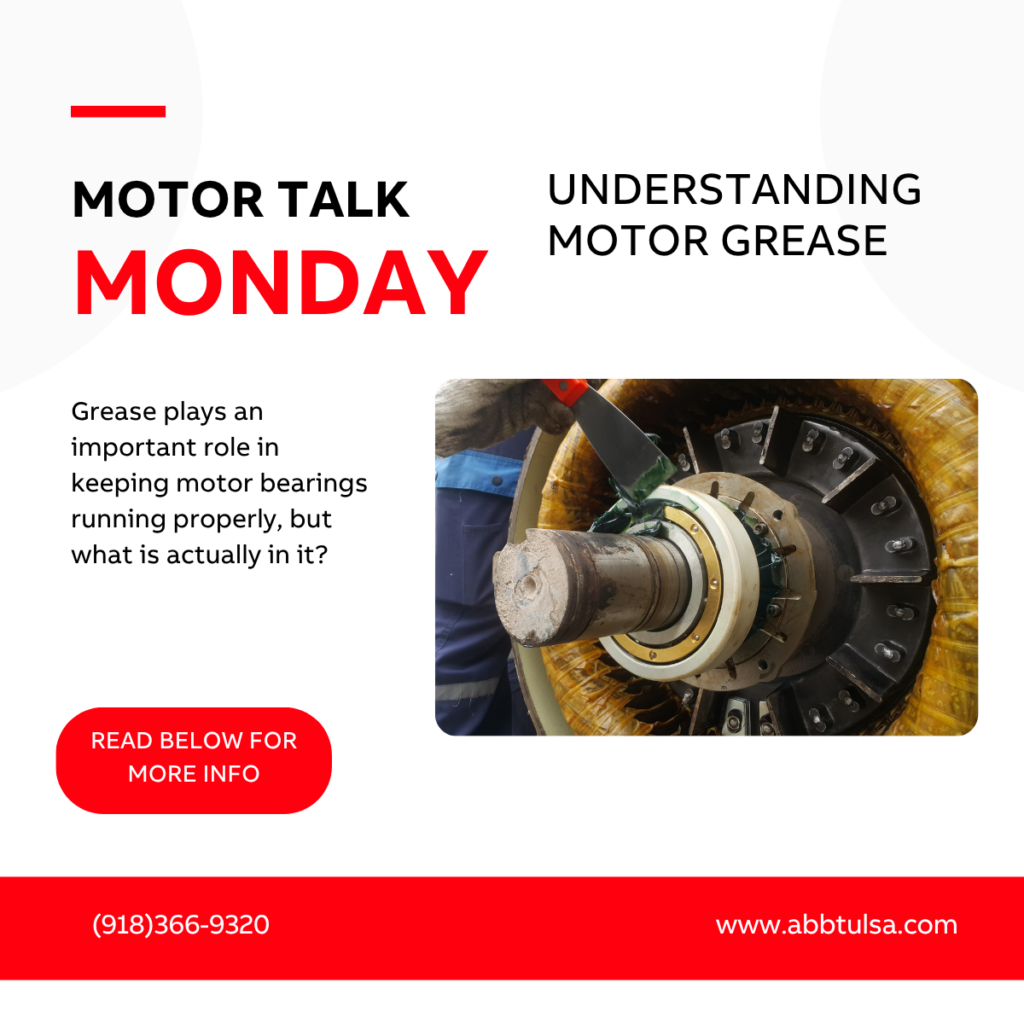
Grease plays an important role in keeping electric motor bearings running properly. But what is actually in motor grease, and how does it provide lubrication?
Most lubricating greases consist of three main components: base oil, thickener, and additives. Each serves a different purpose, and together they create a lubricant that can remain in place and help protect bearing surfaces during operation.
What Is Motor Grease Made Of?
Although grease may look like one uniform material, its components perform different functions.
Base oil: The base oil provides the primary lubrication. During operation, it helps form a lubricating film between moving bearing surfaces, reducing friction and wear. The properties of the base oil, including its viscosity, are an important part of how a grease performs in a particular application.
Thickener: The thickener gives grease its semi-solid consistency and helps retain the lubricant where it is needed. This allows grease to remain in and around the bearing rather than flowing away as readily as oil would.
Additives: Grease formulations may also contain additives designed to enhance specific properties. Depending on the formulation, these may help protect against wear, oxidation, corrosion, or other operating challenges.
The exact formulation varies from one grease to another, which is one reason selecting the correct grease for an electric motor is important.
Why the Right Grease Matters
Greases that look similar are not necessarily interchangeable. They may contain different base oils, thickener systems, or additives, and some grease formulations may be incompatible when mixed.
Mixing incompatible greases can change the consistency and performance of the lubricant. When changing grease types or servicing a motor, always follow the motor manufacturer’s lubrication recommendations rather than assuming two greases can be used together.
More Grease Isn’t Always Better
If grease protects a bearing, adding extra might seem like additional protection. In reality, overgreasing can cause problems.
Excess grease can increase churning as the bearing rotates. This can raise operating temperature and increase the work required to move through the grease. In some cases, excessive grease can contribute to premature bearing problems rather than preventing them.
That is why both the type and quantity of grease matter.
Proper Lubrication Starts With the Motor
There is no single grease or relubrication schedule that is right for every electric motor. Bearing design, motor speed, operating conditions, temperature, and other factors can influence lubrication requirements.
Always refer to the lubrication instructions for your specific motor and application. Following the recommended grease type, quantity, and relubrication interval can help support reliable bearing performance and motor life.
Want to learn more about proper motor lubrication? Read our previous Motor Talk Monday, Bearing Lubrication, for more on lubrication practices and why they matter.
Understanding what is inside motor grease helps explain why proper lubrication involves more than simply adding grease. The right lubricant, applied correctly, helps keep your motor bearings performing as intended.