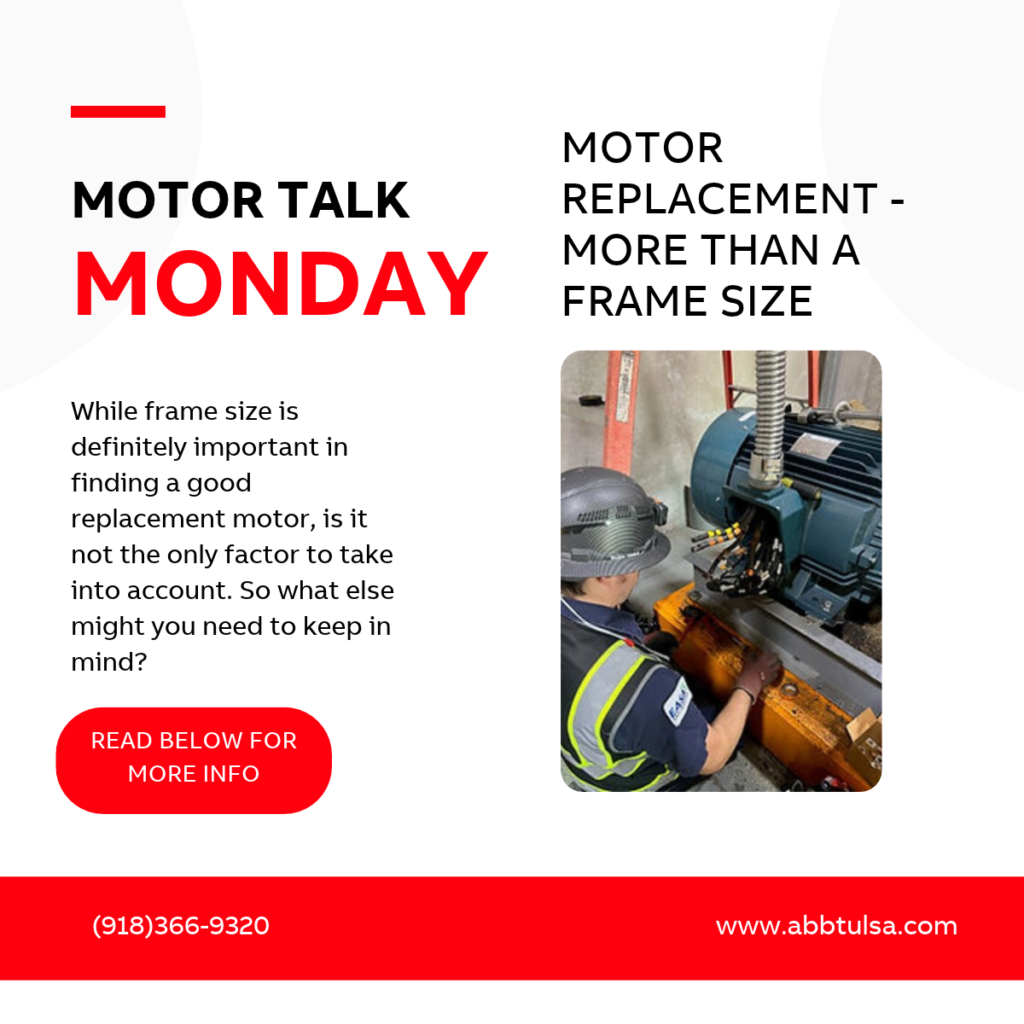
Motor Talk Monday: Motor Replacement – More Than a Frame Size
When an electric motor needs to be replaced, finding a suitable replacement involves more than matching its horsepower or frame size. While these specifications are important starting points, several other factors determine whether a replacement motor will operate properly in an existing application.
Selecting the wrong motor can lead to installation challenges, reduced performance, equipment damage, or unexpected downtime. Understanding which specifications to verify can help make the replacement process smoother and more reliable.
Why Motor Frame Size Matters
Motor frame size is one of the first specifications to consider when selecting a replacement motor.
The National Electrical Manufacturers Association (NEMA) establishes standardized frame dimensions for many electric motors. These standards help provide dimensional consistency across manufacturers, making it easier to identify motors with compatible mounting arrangements.
However, matching frame sizes does not automatically guarantee that two motors are interchangeable.
Different mounting configurations, shaft arrangements, and special design features can affect compatibility, even when motors share the same basic frame designation.
For more information, check out our previous Motor Talk Monday articles on motor frame sizes and NEMA dimensions.
Key Specifications to Verify When Replacing a Motor
Beyond frame size, several electrical and mechanical characteristics should be evaluated before selecting a replacement.
1. Horsepower
A motor’s horsepower rating indicates its rated mechanical output power.
When selecting a replacement, it is important to ensure the motor can meet the application’s power requirements under its intended operating conditions.
An undersized motor may experience overloading and overheating, while selecting a motor with substantially more capacity than necessary may introduce unnecessary costs and efficiency considerations.
The goal is to select a motor appropriately rated for the load rather than simply choosing the highest available horsepower.
2. Speed (RPM)
Motor speed is another important consideration, particularly for equipment such as pumps, fans, and conveyors.
A motor’s rated speed is typically listed on its nameplate in revolutions per minute (RPM).
Even relatively small differences in operating speed can affect equipment performance. For example, increasing the speed of a centrifugal pump or fan can significantly increase its power requirements.
When replacing a motor, verify that its speed characteristics are appropriate for the driven equipment and operating conditions.
3. Voltage and Frequency
The replacement motor must be compatible with the available electrical supply.
Voltage and frequency affect motor performance, including operating speed, current, and temperature.
Before selecting a replacement, verify the motor’s rated voltage, frequency, and phase against the application’s electrical requirements.
Operating a motor outside its intended electrical ratings can lead to performance problems, overheating, or premature failure.
4. Enclosure and Operating Environment
Not all electric motors are designed for the same operating conditions.
Motor enclosures help determine how a motor is cooled and how its internal components are protected from environmental contaminants.
For example, an open drip-proof (ODP) motor and a totally enclosed fan-cooled (TEFC) motor have different enclosure characteristics and may not be suitable for the same environments.
When selecting a replacement, consider environmental factors such as:
- Moisture and humidity
- Dust and airborne contaminants
- Ambient temperature
- Indoor or outdoor installation
- Exposure to chemicals or corrosive conditions
Choosing an enclosure appropriate for the operating environment helps support reliable motor performance and service life.
5. Mounting Configuration
Even when a replacement motor has the correct frame size, its mounting arrangement must be compatible with the existing equipment.
Foot-mounted, flange-mounted, and face-mounted motors have different installation requirements. Shaft dimensions, orientation, and other mechanical characteristics may also affect compatibility.
Verifying these details before ordering can help avoid unexpected modifications, installation delays, and additional downtime.
Additional Application-Specific Considerations
While the specifications above provide a starting point, some applications require additional evaluation.
Depending on the equipment and operating conditions, other important factors may include:
- Starting torque: The motor must provide sufficient torque to accelerate the connected load.
- Duty requirements: The motor should be suitable for the application’s operating cycle, including continuous or intermittent operation.
- Service factor: The motor’s service factor and applicable operating conditions should be considered when evaluating its load capability.
- Bearing arrangements: Certain applications require specific bearing configurations to accommodate radial or axial loads.
- Motor controls: Compatibility with the existing starting method or variable frequency drive (VFD), if applicable, should also be verified.
These considerations are especially important when replacing motors in demanding industrial applications or when the replacement differs from the original design.
A Motor That Fits Isn’t Always the Right Motor
Replacing an electric motor involves more than finding one with the same horsepower, speed, or frame size.
Although standardized dimensions help simplify motor replacement, proper motor selection requires evaluating both the motor’s specifications and the application’s operating requirements.
Taking the time to verify electrical ratings, mechanical compatibility, environmental conditions, and application-specific needs can help prevent installation issues and unnecessary downtime.
If you’re unsure which specifications to consider when replacing a motor, the team at ABB District Office of Tulsa can help identify an appropriate solution for your application.