
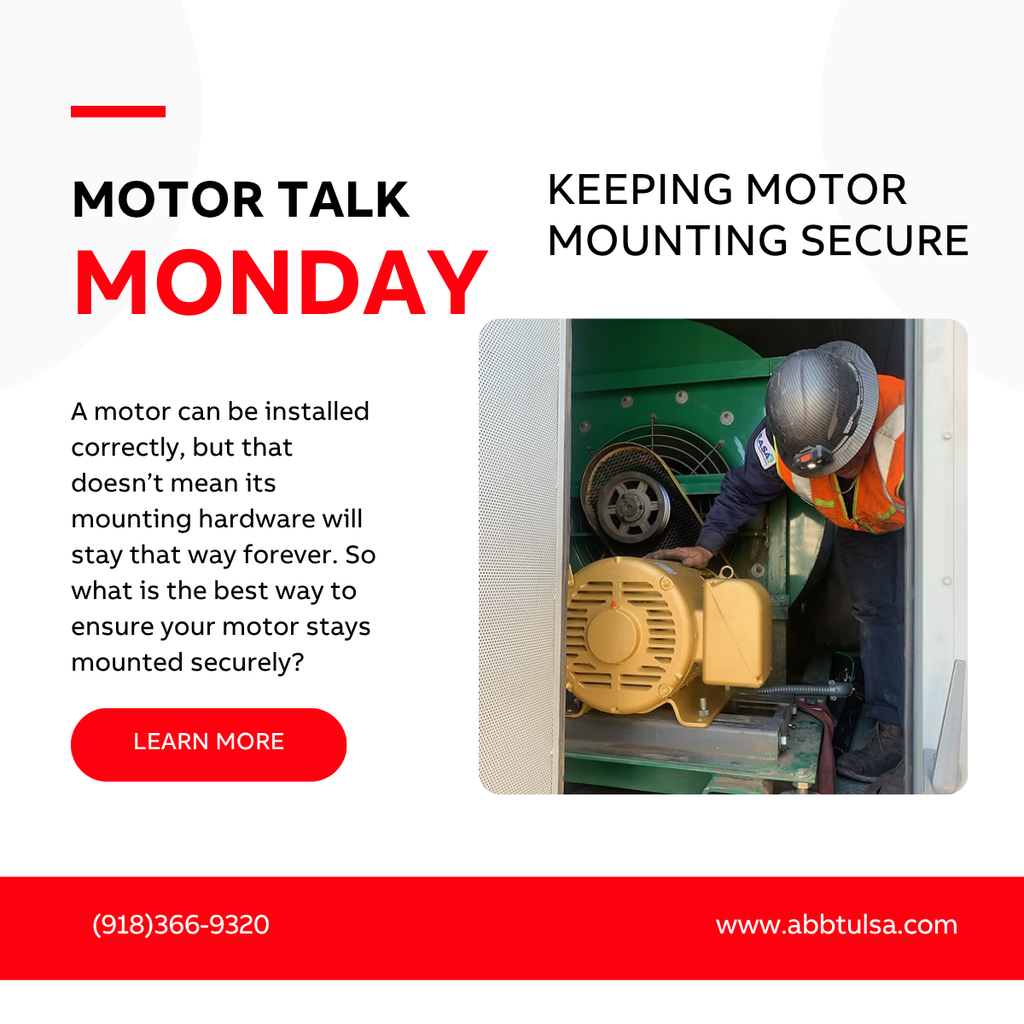
#MotorTalkMonday: Keeping Motor Mounting Secure
Proper motor mounting doesn’t end once installation is complete. A motor that was securely mounted when it entered service should still have its mounting hardware checked as part of routine maintenance.
Over time, vibration, thermal cycling, and equipment movement can contribute to mounting hardware becoming loose. If a motor is no longer held securely in place, that movement can create additional problems for both the motor and the driven equipment.
Why Secure Mounting Matters
An electric motor and the equipment it drives are designed to operate as a properly installed system. The motor needs a stable mounting surface and secure hardware to maintain its position during operation.
When mounting hardware becomes loose, the motor may be able to move at its mounting points. Even small amounts of movement can increase vibration and may affect alignment between the motor and driven equipment. That can contribute to additional stress on components such as bearings, couplings, shafts, and mounting hardware.
Proper installation is the first step toward preventing these issues. For more on motor mounting surfaces, alignment, drain orientation, and installation considerations, read our earlier Motor Talk Monday, Why Motor Mounting Matters.
Why Can Motor Mounting Hardware Become Loose?
Several factors can contribute to mounting hardware loosening over time.
Vibration: Motors and driven equipment naturally experience some vibration during operation. Excessive or changing vibration can place additional stress on mounting points and may contribute to hardware loosening.
Thermal cycling: Motors heat up during operation and cool down when they are shut off. Repeated heating and cooling can cause small dimensional changes in components and connections over time.
Equipment movement: Movement or vibration elsewhere in the driven system can affect the motor and its mounting points.
Mounting problems: An uneven or unstable mounting surface, soft foot, improper installation, or other underlying mechanical issues can place uneven stress on the motor feet and mounting hardware.
Loose hardware can be more than a maintenance issue on its own. In some cases, it can be a symptom of another problem.
What Should You Look For?
Mounting hardware should be included in routine motor inspections. Look for bolts or other hardware that appear loose, missing, damaged, or different from previous inspections.
Also pay attention to signs that the motor may be moving during operation. Changes in vibration, unusual noise, visible movement, or recurring alignment problems can all warrant a closer inspection of the motor and driven system.
If loose hardware is found, follow the motor and equipment manufacturer’s procedures and specified torque requirements when making corrections. Avoid assuming that simply tightening a loose bolt has solved the underlying problem.
When Loose Hardware Keeps Coming Back
A mounting bolt that repeatedly loosens deserves additional attention.
Recurring looseness may indicate excessive vibration, misalignment, soft foot, an unstable mounting surface, or another issue within the motor-driven system. Continually retightening the hardware without determining why it is becoming loose could allow the underlying condition to continue.
Instead, consider recurring loose hardware a reason to inspect the complete installation and identify the source of the movement or stress.
Make Mounting Hardware Part of Routine Inspections
Motor mounting hardware can be easy to overlook, especially when a motor appears to be operating normally. Adding a quick mounting check to routine inspections can help identify changes before they contribute to larger mechanical problems.
Check that the motor remains securely mounted, watch for changes in vibration or movement, and investigate hardware that repeatedly becomes loose.
A secure motor starts with proper installation, but keeping it secure requires attention throughout its service life.