
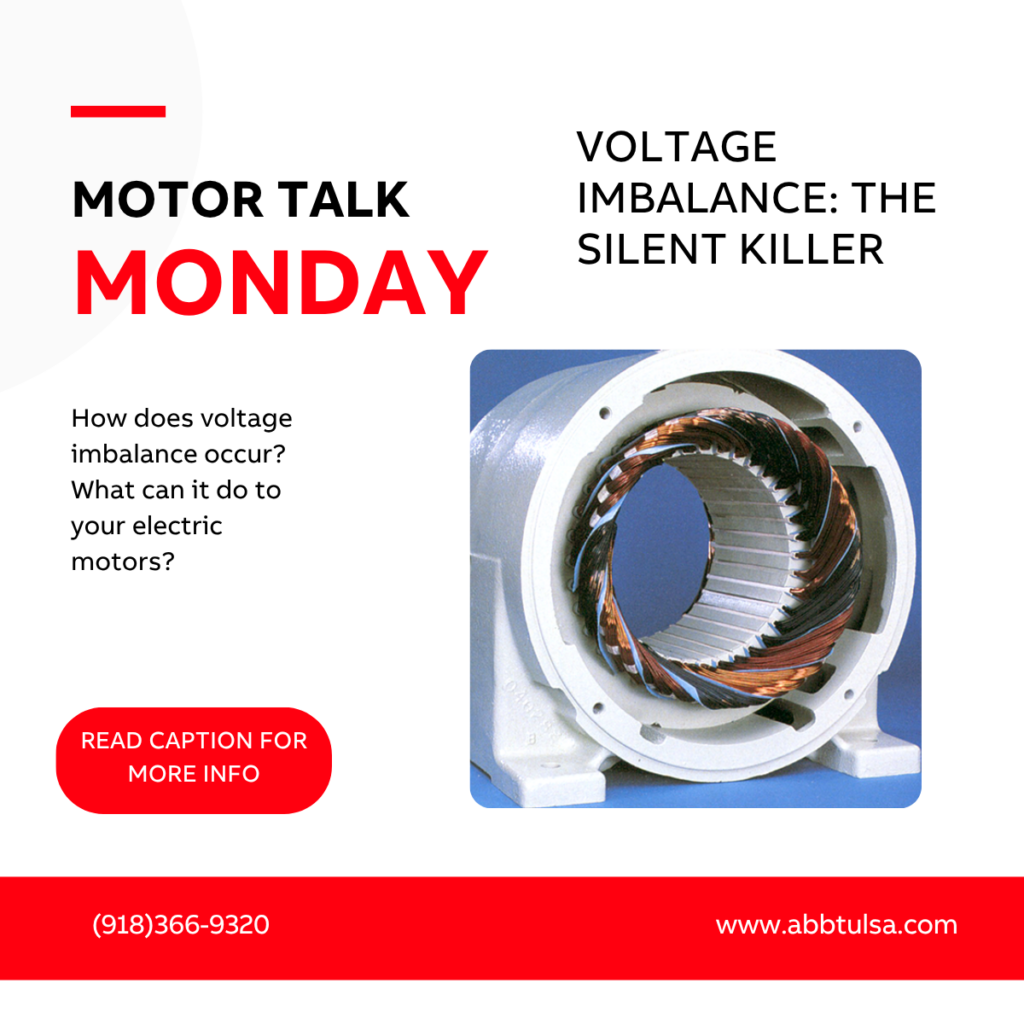
#MotorTalkMonday – Voltage Imbalance: The Silent Motor Killer
Many motor failures occur because of mechanical issues such as bearing wear, contamination, or misalignment. However, electrical problems can be just as damaging. One of the most common—and often overlooked—issues is voltage imbalance.
A motor may appear to be operating normally while an imbalance quietly increases winding temperatures and shortens insulation life.
What Is Voltage Imbalance?
Voltage imbalance occurs when the three phase-to-phase voltages supplying a three-phase motor are not equal.
In a perfect system, all three voltages would be identical. In reality, small differences can occur because of uneven loading, poor electrical connections, transformer problems, or utility power issues.
While the voltage difference may seem minor, the impact on the motor can be significant.
Why Voltage Imbalance Matters
Voltage imbalance creates a much larger current imbalance within the motor windings. As current increases, heat increases.
Excessive heat can lead to:
- Reduced motor efficiency
- Higher operating temperatures
- Decreased insulation life
- Reduced reliability
- Premature motor failure
A commonly cited industry guideline is that a 1% voltage imbalance can create a current imbalance of approximately 6-10%.
How to Calculate Voltage Imbalance
The NEMA method is straightforward:
- Measure all three phase-to-phase voltages.
- Calculate the average voltage.
- Determine the greatest deviation from the average.
- Divide the deviation by the average voltage.
- Multiply by 100.
Example:
Measured voltages:
- 460V
- 455V
- 450V
Average voltage:
(460 + 455 + 450) ÷ 3 = 455V
Maximum deviation:
460V – 455V = 5V
Voltage imbalance:
(5 ÷ 455) × 100 = 1.1%
In this example, the voltage imbalance exceeds the commonly recommended 1% limit.
Common Causes of Voltage Imbalance
Several conditions can create voltage imbalance, including:
- Uneven distribution of single-phase loads
- Loose or corroded electrical connections
- Transformer problems
- Blown fuses on one phase
- Utility power issues
Identifying and correcting these issues early can help prevent motor damage and unplanned downtime.
Final Thoughts
Voltage imbalance is easy to miss because the motor often continues to run. Unfortunately, continued operation under imbalanced voltage conditions can generate excess heat and reduce motor life.
Routine voltage measurements are a simple way to identify potential problems before they become costly failures.
At the ABB District Office of Tulsa, we help customers troubleshoot motor issues and select the right solutions for their applications. If you have questions about motor performance or reliability, contact our team.