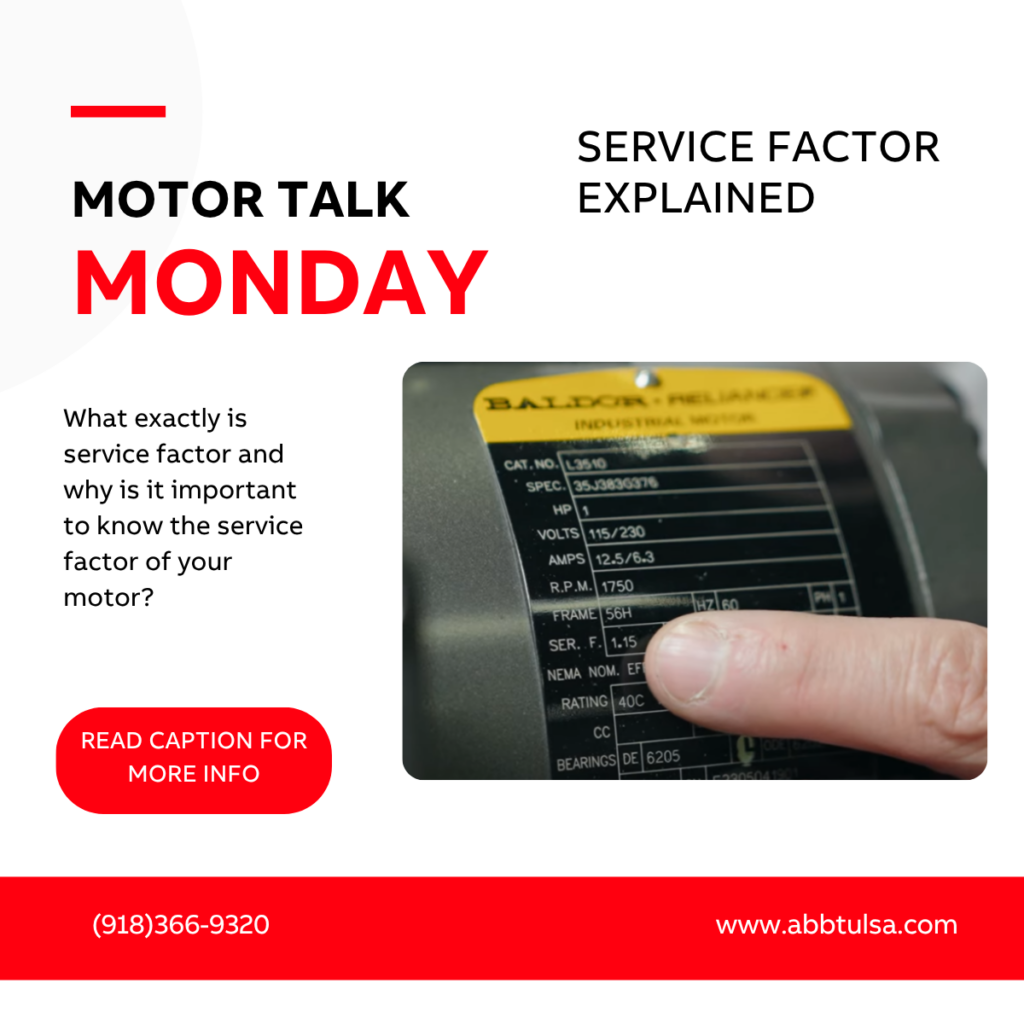
#MotorTalkMonday – Service Factor Explained
When reviewing motor nameplates and specifications, you’ve probably seen the term service factor listed alongside horsepower, voltage, and full load amps. While it may seem like a simple number, service factor is often misunderstood and sometimes misused.
Understanding what service factor means can help improve motor reliability, reduce downtime, and ensure you’re selecting the right motor for the job.
What Is Service Factor?
Service factor (SF) is a multiplier that indicates how much load a motor can handle above its rated horsepower under specified operating conditions.
For example, a motor rated at 100 HP with a service factor of 1.15 can theoretically handle up to 115 HP:
100 HP × 1.15 = 115 HP
This additional capacity provides a margin for occasional overloads, process fluctuations, or unexpected operating conditions.
Does Service Factor Mean Extra Horsepower?
Not exactly.
One of the most common misconceptions is that service factor provides “free horsepower” that can be used continuously. In reality, service factor is intended as a reserve capacity rather than a normal operating point.
While a motor may be capable of operating in its service factor range, doing so on a regular basis can have consequences.
What Happens When a Motor Operates in the Service Factor Range?
As load increases above the motor’s rated horsepower, the motor must work harder to produce the required torque. This can lead to:
- Higher operating temperatures
- Increased insulation stress
- Greater energy consumption
- Reduced bearing life
- Shorter overall motor life
Occasional operation in the service factor range is generally acceptable when conditions warrant it. However, continuous operation above the motor’s rated load may reduce reliability and increase maintenance requirements over time.
Why Service Factor Matters
Service factor provides flexibility when operating conditions aren’t perfectly predictable. It can help accommodate:
- Temporary overloads
- Process upsets
- Variations in driven equipment demand
- Short-term increases in load
This additional margin can be valuable in helping equipment remain operational during unexpected conditions.
Best Practice for Motor Selection
When selecting a motor, it’s generally best to size the motor based on the application’s actual load requirements rather than relying on service factor capacity.
A properly sized motor operating within its rated horsepower will typically provide better efficiency, lower operating temperatures, and longer service life than a motor that regularly depends on its service factor margin.
Final Thoughts
Service factor is an important motor specification, but it shouldn’t be viewed as extra horsepower that’s available for continuous use.
Instead, think of service factor as a built-in safety margin that helps a motor handle occasional overloads and changing operating conditions. Understanding the difference can help improve reliability, extend motor life, and reduce the likelihood of unexpected downtime.
Need help selecting the right motor for your application? The ABB District Office of Tulsa team is here to help.