Motor Talk Monday – Motor Rotation Basics
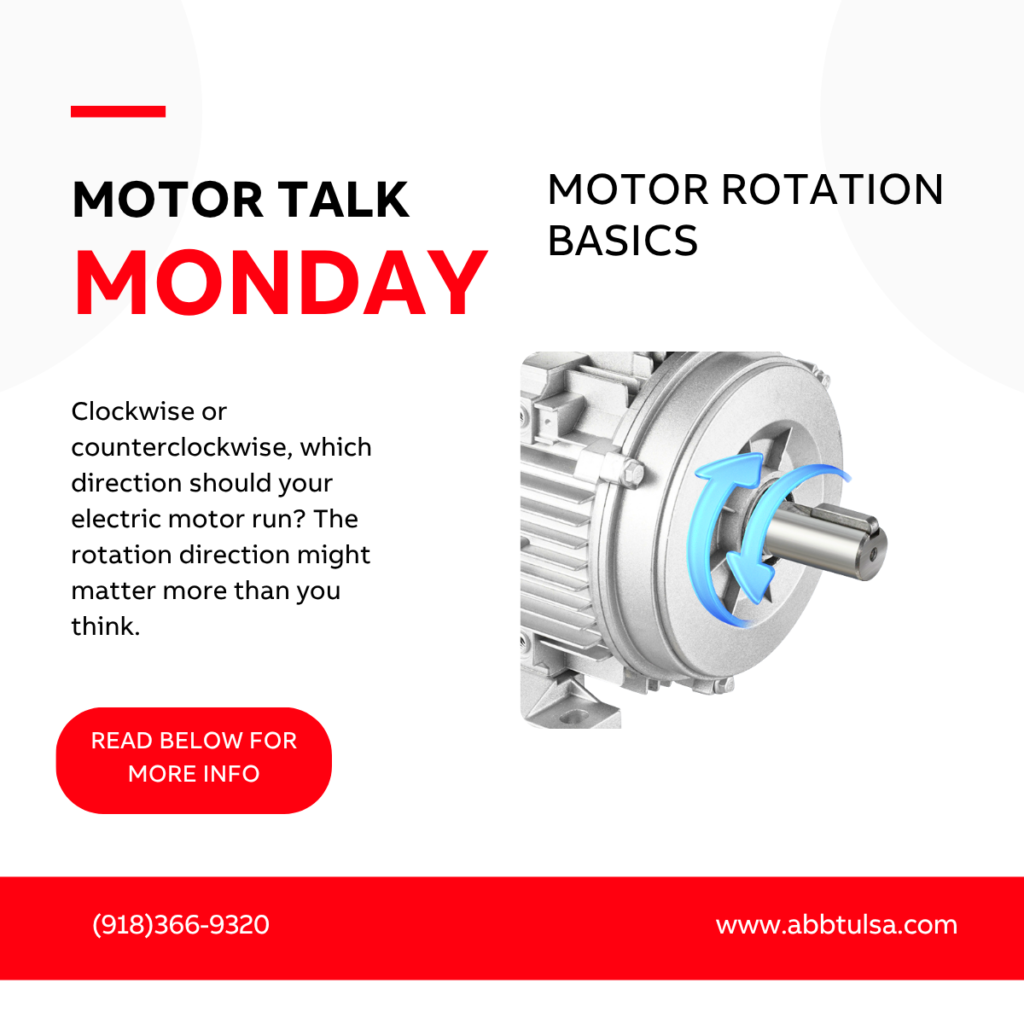
Clockwise or counterclockwise? When it comes to electric motors, the direction of rotation matters more than you might think.
Electric motors power a wide variety of industrial equipment, including pumps, fans, conveyors, and compressors. While many three-phase induction motors can operate in either direction, the equipment they drive often requires a specific direction of rotation. Operating in the wrong direction can reduce performance, disrupt processes, or potentially damage equipment.
Understanding what determines motor rotation, how it can be reversed, and why verification matters can help prevent problems during installation, commissioning, and maintenance.
What Determines Motor Rotation?
In a three-phase induction motor, the direction of rotation is determined by the phase sequence of the incoming electrical supply. Three-phase power creates a rotating magnetic field within the motor’s stator. This magnetic field induces currents in the rotor, producing torque that causes the rotor to turn. The sequence in which the three supply phases reach their respective positions in the electrical cycle determines the direction of the rotating magnetic field.
For a conventional three-phase induction motor connected directly to a three-phase power supply, interchanging any two supply phases reverses the direction of the rotating magnetic field. As a result, the motor rotates in the opposite direction.
Although this electrical principle is relatively straightforward, reversing a motor’s rotation is not always appropriate for the connected equipment.
Why Does Motor Rotation Matter?
Many industrial applications depend on equipment rotating in a specific direction to operate correctly. Even when a motor can operate in either direction, the driven equipment may not.
Pumps: Many centrifugal pumps are designed to rotate in a specific direction. Incorrect rotation can significantly reduce flow and pressure. Depending on the pump design, reverse rotation may also create mechanical problems.
Fans and Blowers: Fan blades and impellers are designed to move air efficiently in a particular direction. Incorrect rotation can reduce airflow and negatively affect system performance.
Conveyors: Reversing motor rotation may cause a conveyor to move in the opposite direction, potentially disrupting material handling or creating unsafe operating conditions.
Compressors: Some compressors have strict rotational requirements. Operating in the wrong direction can interfere with proper operation and may damage internal components.
These examples demonstrate why confirming the required direction of rotation is an important part of motor installation and commissioning.
Clockwise vs. Counterclockwise: Which End Are You Looking At?
When discussing motor rotation, clockwise and counterclockwise can be misleading without identifying the viewing direction. A motor that appears to rotate clockwise when viewed from one end will appear to rotate counterclockwise when viewed from the opposite end.
Two common reference points are:
- Drive End (DE): The end of the motor where power is typically transmitted to the driven equipment, often through a coupling, pulley, or other connection.
- Opposite Drive End (ODE): The end opposite the drive end, sometimes referred to as the non-drive end (NDE).
For example, a motor rotating clockwise when viewed from the drive end will appear to rotate counterclockwise when viewed from the opposite drive end.
This distinction is important when interpreting rotation arrows, technical documentation, or installation instructions. Always verify which viewing direction the manufacturer uses when specifying clockwise or counterclockwise rotation.
Can You Reverse the Direction of a Three-Phase Motor?
For a conventional three-phase induction motor connected directly to a three-phase supply, reversing the direction of rotation generally involves interchanging any two of the three supply phases. This changes the phase sequence and reverses the direction of the motor’s rotating magnetic field.
However, not all motors are designed for operation in both directions.
Some motors have directional cooling systems, bearing arrangements, or other mechanical features that limit their permitted direction of rotation. Additionally, the driven equipment may require a specific direction even if the motor itself can operate in either direction. Motors operated using variable frequency drives (VFDs) also require special consideration. Rotation is typically controlled through the drive’s configuration or control commands rather than by changing incoming supply connections.
Before making changes, qualified personnel should consult the applicable motor, drive, and equipment manufacturer’s instructions.
Why Verify Rotation During Installation and Maintenance?
Verifying rotation is an important step when commissioning a new motor or returning equipment to service after certain maintenance activities.
Changes to electrical connections, motor replacement, or modifications to the power supply can affect the phase sequence and potentially reverse the motor’s direction. Even if a motor appears to be operating normally, that doesn’t necessarily mean it is rotating in the correct direction for its application.
During commissioning, qualified personnel should:
- Confirm the required direction: Review the motor and driven equipment manufacturer’s instructions, nameplate information, and applicable rotation markings.
- Follow the recommended verification procedure: Use the manufacturer’s approved method to verify actual rotation. Depending on the application, this may involve checking phase sequence or performing a controlled rotation check.
- Confirm compatibility with the driven equipment: Ensure the motor’s direction matches the equipment’s operating requirements before placing the system into normal service.
When applicable, follow established electrical safety procedures, including lockout/tagout requirements, before performing work on motor connections or equipment. Never assume a motor’s direction of rotation based solely on previous wiring arrangements.
Getting Motor Rotation Right
Motor rotation may seem like a small detail, but it can have a significant impact on equipment performance and reliability. For three-phase induction motors, phase sequence determines the direction. However, confirming the correct direction involves more than understanding how the motor works electrically. It also requires considering the motor’s design, the driven equipment’s requirements, and the manufacturer’s recommended commissioning procedures.
Remember: A motor may be running, but that doesn’t necessarily mean it’s running in the right direction.