Motor Talk Monday: What Does Continuous Duty Mean?
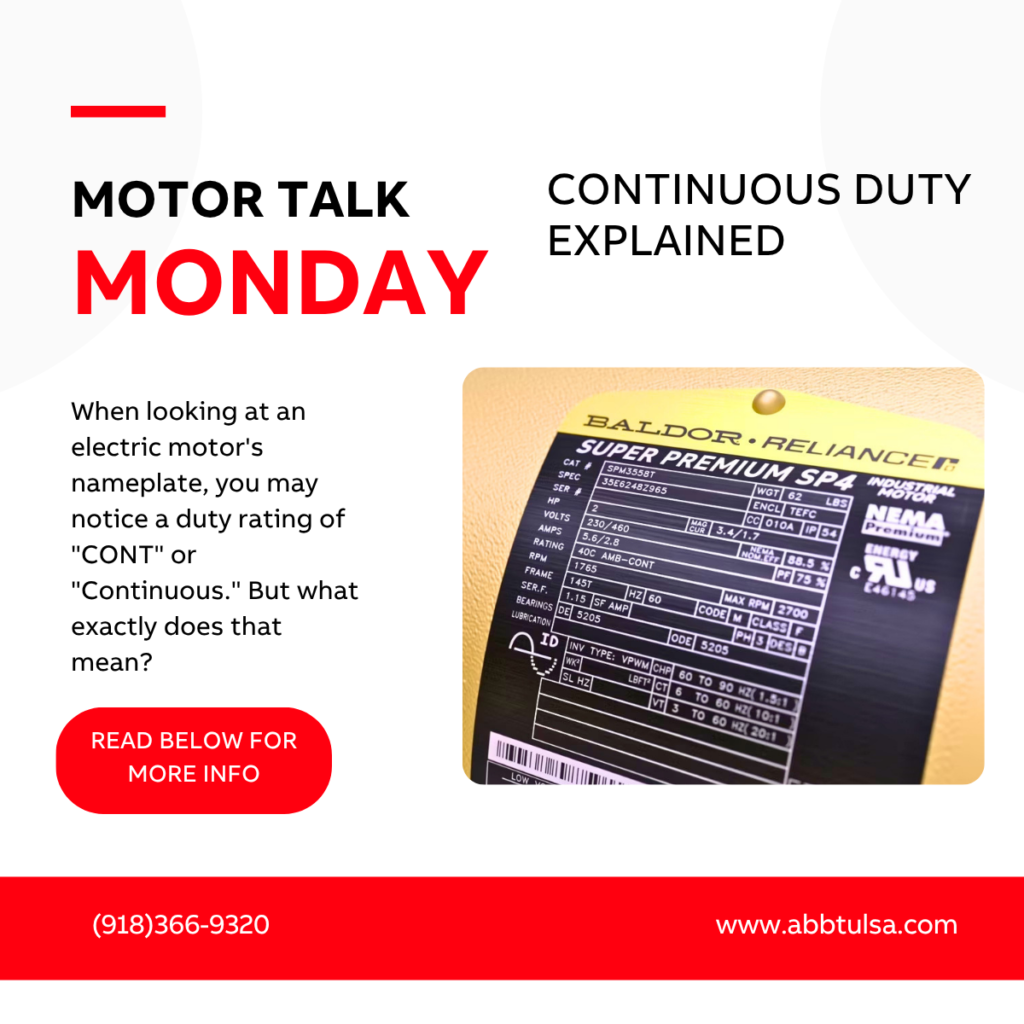
When looking at an electric motor’s nameplate, you may notice a duty rating labeled “CONT” or “Continuous.” While the term may seem self-explanatory, understanding what continuous duty actually means can help ensure a motor is properly matched to its application.
A continuous-duty motor is designed to operate at its rated load for an extended period without requiring scheduled rest or cooling periods. However, that doesn’t mean the motor can operate under any conditions indefinitely.
Understanding how duty ratings relate to temperature, loading, and operating conditions is an important part of selecting and maintaining electric motors.
What Is Continuous Duty?
Continuous duty describes a motor’s ability to operate at a constant load long enough to reach thermal equilibrium without exceeding its allowable temperature limits.
In simple terms, a continuous-duty motor can operate at its rated load without needing periodic shutdowns to cool down, provided it remains within its specified operating conditions.
Under the IEC 60034-1 duty classification system, continuous running duty is designated S1. This classification describes operation at a constant load for sufficient time to reach thermal equilibrium.
For many industrial applications, continuous-duty motors are a common choice because equipment may need to operate for long periods without interruption.
Examples include pumps, fans, conveyors, and other equipment that may run for extended periods.
How Temperature Rise Affects Continuous Operation
Electric motors generate heat during operation due to electrical and mechanical losses. As the motor runs, its internal temperature increases.
At the same time, the motor dissipates heat through its frame and cooling system.
Eventually, under stable operating conditions, the motor reaches thermal equilibrium. At this point, the rate of heat generation is balanced by the rate of heat dissipation, and the motor’s temperature stabilizes.
Continuous-duty motors are designed to operate under these steady-state conditions without exceeding their specified temperature limits.
However, several factors can influence a motor’s operating temperature, including:
- Ambient temperature: Higher surrounding temperatures can reduce the motor’s ability to dissipate heat.
- Ventilation: Restricted airflow or blocked cooling passages can interfere with heat dissipation.
- Loading: Operating above the motor’s rated load can increase heat generation.
- Voltage conditions: Voltage outside the motor’s specified operating range or excessive voltage imbalance can contribute to additional heating.
- Altitude: Reduced air density at higher elevations can affect cooling performance.
These factors help explain why a continuous-duty rating doesn’t guarantee unlimited operation under all circumstances.
Even a motor designed for continuous operation must remain within its specified electrical, mechanical, and environmental limits.
Continuous Duty vs. Other Motor Duty Ratings
Not every electric motor is designed to operate continuously at its rated load.
Different applications have different operating cycles, and motor duty ratings help identify the conditions a motor is designed to handle.
Under IEC 60034-1, several duty classifications describe different operating patterns.
S1 – Continuous Running Duty
The motor operates at a constant load long enough to reach thermal equilibrium. It does not require scheduled cooling periods between operating cycles.
S2 – Short-Time Duty
The motor operates at a constant load for a specified period that is too short to reach thermal equilibrium. It then remains de-energized long enough to return approximately to the temperature of the surrounding cooling medium.
S3 – Intermittent Periodic Duty
The motor operates through repeated cycles of constant-load operation and rest. The operating periods are not long enough to reach thermal equilibrium, and starting losses are not significant enough to affect the temperature rise appreciably.
Additional duty classifications account for factors such as starting, electrical braking, changes in load, and changes in speed.
These classifications are important because a motor designed for intermittent operation may not be suitable for an application requiring continuous operation at the same load.
Does Continuous Duty Mean a Motor Can Run 24/7?
In many cases, yes!
A properly selected continuous-duty motor can operate 24 hours a day, seven days a week, provided it remains within its rated operating conditions.
However, continuous duty does not mean maintenance-free operation or unlimited motor life.
Bearings, lubrication, insulation, and other components still experience wear and aging during operation. Regular inspections and preventive maintenance remain important, even when a motor is designed to run continuously.
Additionally, operating conditions can change over time. Increased loading, restricted cooling airflow, or changes in the driven equipment can affect motor performance and operating temperature.
Continuous operation is a design capability, not a guarantee that the motor will operate indefinitely without maintenance or failure.
Why Motor Duty Ratings Matter
Selecting a motor with the appropriate duty rating helps ensure it can handle the demands of its application.
A motor intended for short periods of operation may experience excessive heating if it is used continuously at a load beyond its continuous thermal capability.
Conversely, some intermittent applications may require special consideration for frequent starts, changing loads, or repeated acceleration and deceleration.
When selecting a motor, consider how long it will operate, the load it will experience, how frequently it will start and stop, and the environmental conditions in which it will operate.
These factors, along with the motor’s nameplate ratings and manufacturer specifications, help determine whether it is suitable for the application.
Understanding Your Motor’s Capabilities
Continuous duty is one of several important ratings that describe how an electric motor is designed to operate.
A continuous-duty motor can operate at its rated load long enough to reach thermal equilibrium without requiring scheduled cooling periods. However, its ability to do so depends on maintaining the specified operating conditions.
Understanding duty ratings can help prevent improper motor selection, reduce the risk of overheating, and support reliable equipment operation.
The next time you see “CONT” on a motor nameplate, remember that it describes more than how long the motor can run. It also reflects the motor’s ability to manage heat during sustained operation.