Motor Talk Monday – Squirrel Cage Explained
You’ve probably heard of squirrel cage induction motors, but do you know what the term “squirrel cage” actually refers to?
Despite the unusual name, it describes one of the most common rotor designs found in industrial AC motors. The name comes directly from the rotor’s construction and the cage-like structure hidden inside the motor.
What’s Inside a Squirrel Cage Rotor?
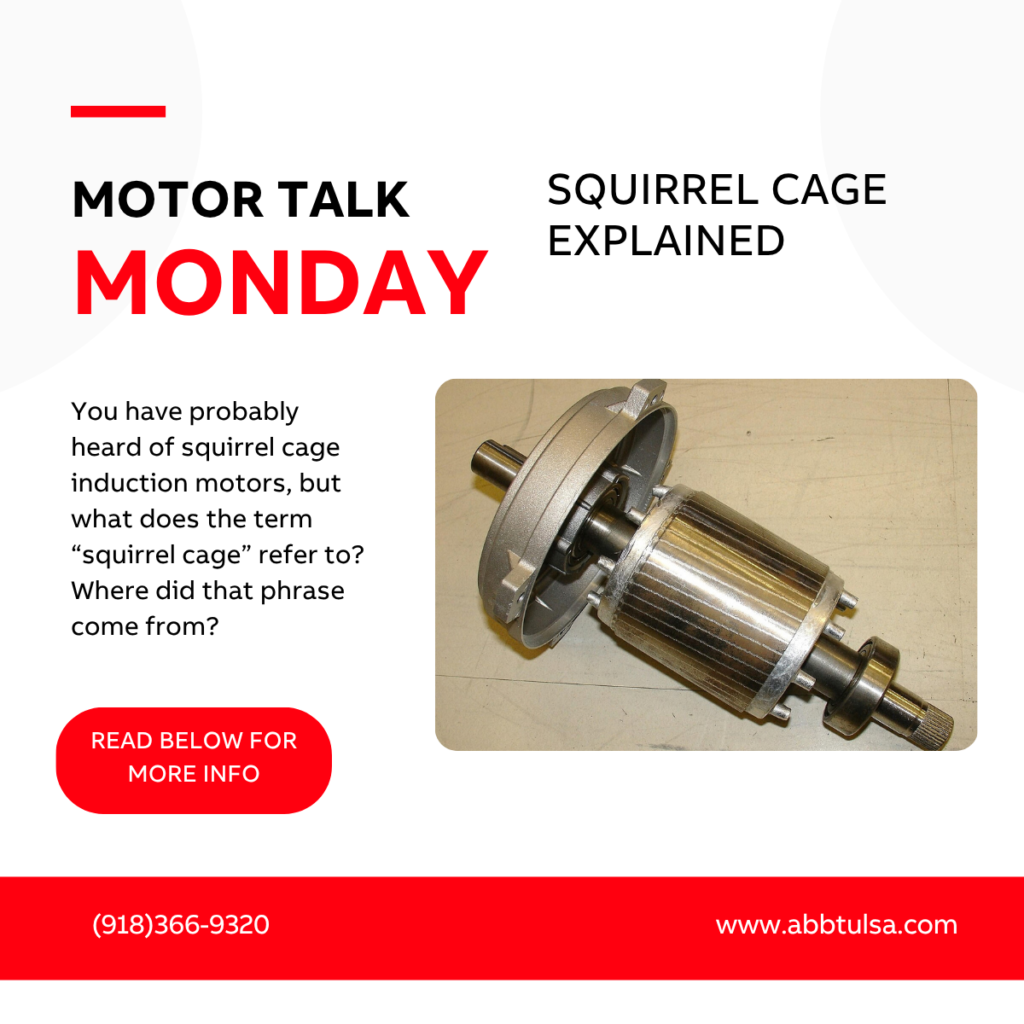
A squirrel cage rotor contains conductive bars, typically made of aluminum or copper, that run lengthwise through the rotor. These bars are connected at both ends by shorting rings, forming a closed electrical circuit. Together, the rotor bars and end rings create a structure that resembles a cage, giving the squirrel cage rotor its name.
The conductive cage is built into a laminated steel rotor core. The rotor bars are also commonly skewed rather than running perfectly parallel to the shaft. Skewing the bars can help reduce magnetic noise and torque variations and contribute to smoother motor operation.
Unlike a wound rotor, the squirrel cage rotor does not need brushes, slip rings, or an external electrical connection to the rotor circuit. Instead, the electrical current in the rotor is created through electromagnetic induction.
How Does the Squirrel Cage Produce Torque?
The squirrel cage may look relatively simple, but it plays a critical role in converting electrical energy into mechanical motion.
When AC power is applied to the stator windings of an induction motor, the stator produces a rotating magnetic field. This magnetic field moves around the stationary rotor at synchronous speed.
Because there is relative motion between the rotating magnetic field and the rotor bars, voltage is induced in the conductive bars. Since the bars are connected by the end rings, current can flow through the rotor cage.
That rotor current creates its own magnetic field. The interaction between the stator’s rotating magnetic field and the magnetic field produced by the rotor creates torque, causing the rotor and shaft to turn. There is no direct electrical connection supplying current to the rotor. The stator’s magnetic field induces current in it, which is where the term “induction motor” comes from.
Why Doesn’t the Rotor Reach Synchronous Speed?
An important part of squirrel cage induction motor operation is something called slip.
The rotor must rotate slightly slower than the stator’s rotating magnetic field for induction to occur. If the rotor were to reach the same speed as the rotating magnetic field, there would be no relative motion between the two. Without that relative motion, voltage would no longer be induced in the rotor bars, rotor current would fall, and the motor would no longer produce the torque needed to maintain that speed under load.
To learn more about slip, check out this past Motor Talk Monday post: Motor Talk Monday – Induction Motor Slip
Why Are Squirrel Cage Motors So Common?
The simplicity of the squirrel cage design is one of its biggest advantages. Because the rotor does not require brushes, slip rings, or direct electrical connections, there are fewer components to wear or maintain.
This contributes to several characteristics that make squirrel cage induction motors well suited for industrial applications:
- Simple, rugged rotor construction
- High reliability
- Relatively low maintenance requirements
- Cost-effective construction
- Suitability for a wide range of industrial loads and operating environments
These characteristics have helped make these motors a common choice for applications such as pumps, fans, compressors, conveyors, and other industrial equipment.
Simple Design, Important Job
The term “squirrel cage” might sound unusual, but the technology behind it is fundamental to industrial motor operation. Those conductive bars and shorting rings provide a simple way for the stator’s rotating magnetic field to induce current in the rotor and produce torque without requiring a direct electrical connection to the rotating component.
So, while you won’t find an actual squirrel inside your motor, you will find a simple, rugged rotor design that helps keep industrial equipment turning every day.