
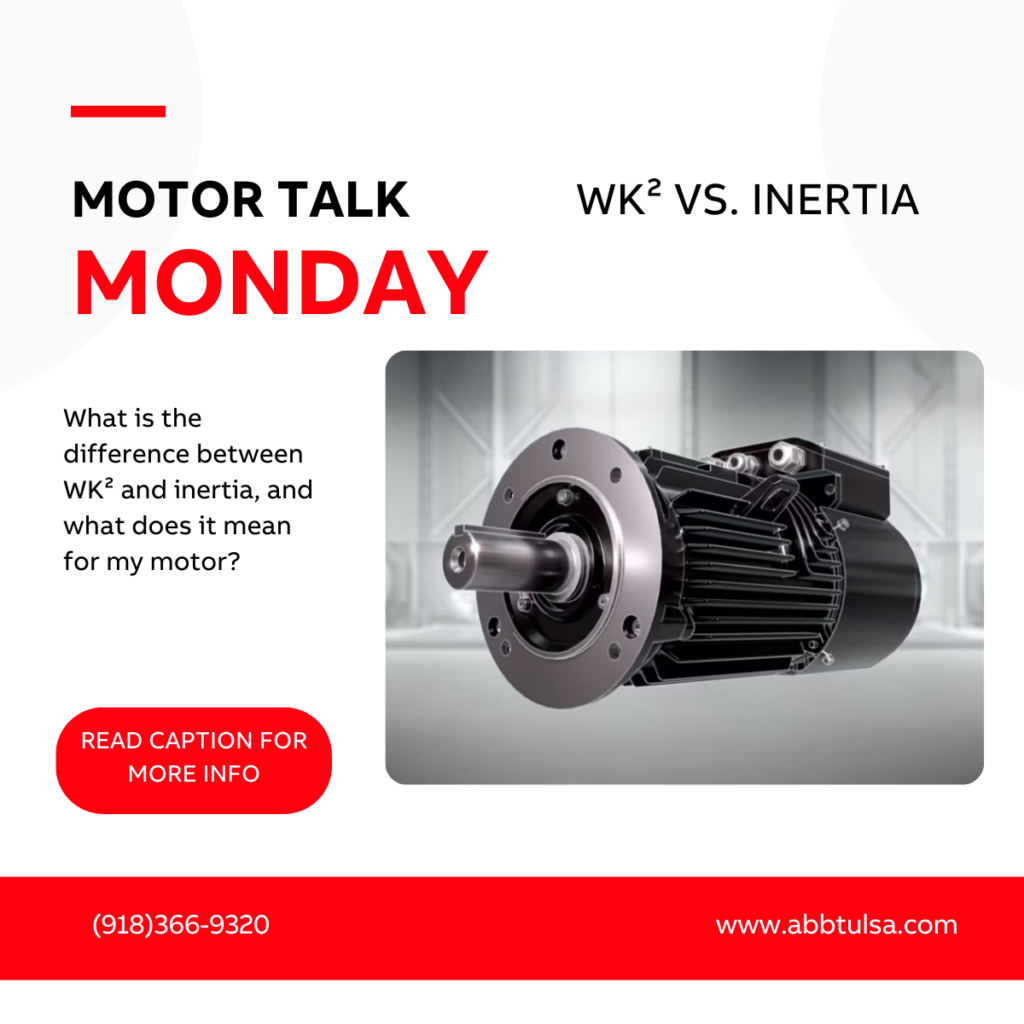
#MotorTalkMonday – WK² vs. inertia
When sizing or troubleshooting a motor, you will often see the term WK². While it relates to inertia, it is not exactly the same thing. Understanding the difference helps prevent undersized motors, long acceleration times, and unexpected downtime.
Let’s break it down.
What Is WK²?
WK² (pronounced “W-K-squared”) is the industry’s practical way of expressing rotational inertia in U.S. customary units.
- W represents weight (lb)
- K is the radius of gyration
- K² reflects how that weight distributes around the shaft centerline
In simple terms, WK² tells you how difficult it is to change the speed of a rotating component.
The farther the weight sits from the axis of rotation, the larger the K value becomes. As a result, the WK² increases. When WK² increases, the load requires more torque to accelerate.
How Is That Different from Inertia?
In physics, engineers express true mass moment of inertia as J (lb-ft-s² or kg-m²). This value depends strictly on mass and geometry.
However, WK² uses weight instead of mass. That difference makes WK² more convenient for motor calculations in the United States. Engineers can apply it directly when evaluating:
- Acceleration torque
- Starting current
- Acceleration time
- Shaft stress
- Thermal impact during startup
Because of this direct relationship, most motor manufacturers publish WK² values for rotors and recommend that users calculate total system WK² during motor selection.
Why WK² Matters in Motor Applications
WK² becomes especially important when you work with high-inertia loads. These applications typically include:
- Fans
- Pumps
- Compressors
- Paper-machine rolls
- Generators
High WK² means the motor must deliver enough torque to bring the system up to speed within an acceptable time. If it cannot, several problems can occur.
For example, the motor may draw excessive starting current. It may also experience extended heating during acceleration. In severe cases, you could see mechanical stress on shafts and couplings.
Therefore, proper WK² evaluation protects both electrical and mechanical components. It also improves startup reliability and reduces the risk of downtime.
The Bottom Line
WK² and inertia describe similar concepts, but they are not interchangeable. In motor applications, WK² provides a practical way to evaluate how a load will affect acceleration, current draw, and thermal performance.
When you account for WK² during motor selection, you reduce startup issues, limit overheating, and improve overall system reliability.