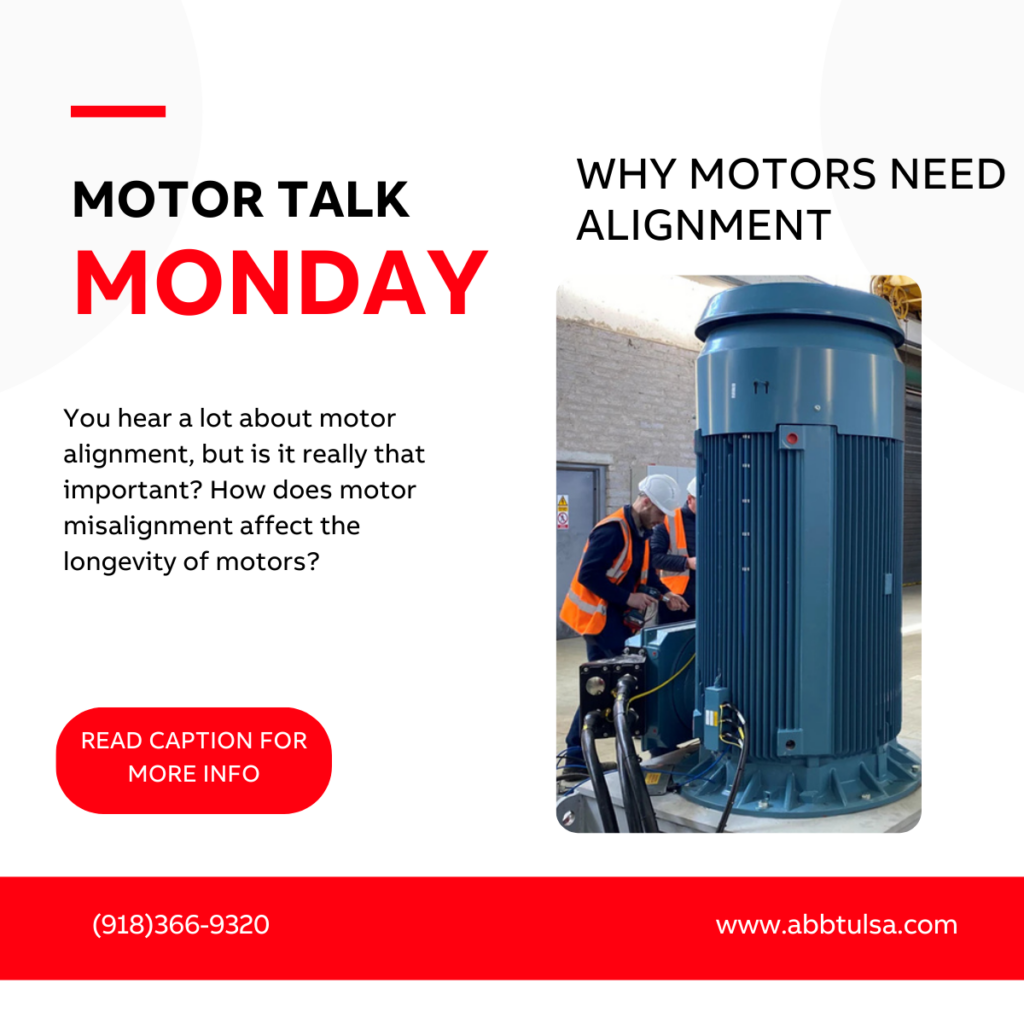
Misalignment is a silent killer of electric motors and driven equipment.
When a motor is installed or maintained, one of the most critical — yet often overlooked — steps is shaft alignment. Proper alignment between the motor shaft and the driven equipment shaft isn’t just a best practice; it’s essential for reliability, efficiency, and longevity.
What Is Motor Alignment?
Motor alignment refers to the precise positioning of two rotating shafts so they share a common centerline during operation. Even when shafts appear aligned at rest, thermal expansion, foundation settling, and operational loads can shift components out of alignment.
There are two types of misalignment:
- Angular misalignment – The shaft centerlines meet at an angle
- Parallel (offset) misalignment – The shafts are parallel but not on the same centerline
Most real-world misalignment is a combination of both.
The Consequences of Misalignment
1. Premature Bearing Failure
Misalignment imposes radial and axial loads that bearings weren’t designed to handle. This accelerates wear, increases operating temperature, and can reduce bearing life by 50% or more. In severe cases, bearings can fail within months instead of years.
2. Excessive Vibration
Misaligned shafts generate vibration that propagates through the motor, coupling, and driven equipment. Over time, this vibration loosens mounting bolts, cracks foundations, fatigues shafts, and stresses mechanical seals. It also makes condition monitoring more difficult, masking other developing issues.
3. Increased Energy Consumption
When shafts are misaligned, friction and drag increase. The motor must work harder to overcome these forces, consuming more electricity to deliver the same output. This inefficiency translates directly into higher operating costs and wasted energy.
4. Coupling Damage
Flexible couplings are designed to accommodate minor misalignment, but they’re not a substitute for proper alignment. Chronic misalignment causes couplings to wear out faster, overheat, and transfer destructive forces to connected components. Rigid couplings offer no forgiveness and will transmit full misalignment loads to bearings and shafts.
5. Seal Leakage
Misalignment can cause shaft deflection that damages mechanical seals, leading to lubricant leakage, contamination, and additional bearing wear.
How to Achieve Proper Alignment
Precision alignment requires the right tools and techniques:
- Dial indicators – Traditional method using precision gauges to measure shaft position
- Laser alignment systems – Modern, highly accurate tools that provide real-time feedback and digital documentation
- Straightedges and feeler gauges – Useful for rough alignment checks
Alignment should be checked:
- During initial installation
- After motor replacement or maintenance
- Following foundation work or grouting
- Periodically as part of predictive maintenance programs
- When vibration levels increase
Remember that alignment can differ with temperature changes. Motors and equipment expand as they heat up during operation, so alignment procedures must account for thermal growth to ensure the motor remains aligned at operating temperature.
The Bottom Line
A few hours spent on precision alignment during installation or maintenance can prevent thousands of dollars in repairs, reduce energy costs, and eliminate unplanned downtime. Misalignment might be invisible, but its effects are costly and predictable.
Protect your motor investment with proper alignment — your bearings, your budget, and your maintenance team will thank you.
Need help with motor selection, installation guidance, or technical support? Contact ABB District Office of Tulsa for expert assistance.
#ABB #ABBMotors #MotorAlignment #PredictiveMaintenance #Outrun #EngineeredToOutrun