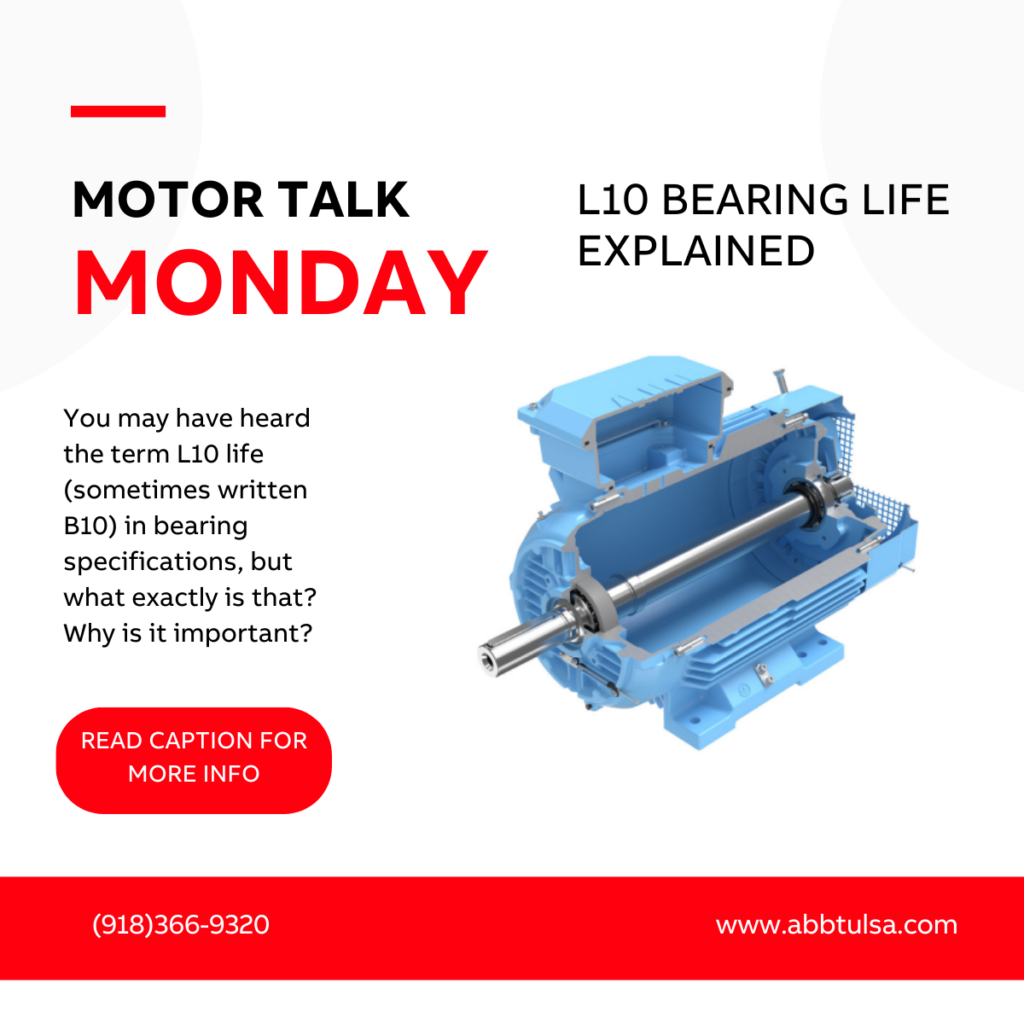
#MotorTalkMonday – L10 bearing life explained
What Is L10 Life?
When selecting or evaluating rolling-element bearings, you may see the term L10 life (sometimes written B10 life). This value is commonly used in bearing catalogs and engineering calculations. However, it is often misunderstood in real-world motor applications.
Understanding what L10 life represents (and what it does not) can help engineers and maintenance teams make better reliability decisions.
The Statistical Meaning of L10 Life
L10 life is a statistical measure of bearing fatigue life.
It represents the number of operating hours at which 90% of a group of identical bearings are expected to still be operating, while 10% may have failed due to fatigue-related mechanisms.
This concept comes from long-term testing by manufacturers. Even when bearings operate under identical conditions, they do not all fail at the same time. Instead, their life follows a statistical distribution driven largely by subsurface metal fatigue.
Because of this variation, L10 life provides a probabilistic estimate, not an exact service life.
How L10 Life Is Calculated
L10 life is calculated using two primary values:
- Dynamic load rating of the bearing
- Equivalent operating load applied to the bearing
The relationship between load and life is exponential. As a result, small reductions in load can significantly increase expected bearing life. Conversely, increased loads reduce expected life.
Modern calculations often use adjusted life models based on ISO standards. These may also account for:
- Lubrication quality
- Contamination levels
- Material properties
- Reliability factors
These adjustments help provide a more realistic estimate of fatigue life.
What L10 Life Does Not Predict
L10 life focuses on fatigue-related failures under controlled conditions. However, many bearing failures in industrial environments occur for completely different reasons.
Common real-world causes of bearing failure include:
- Poor or inadequate lubrication
- Contamination from dust, water, or debris
- Misalignment or improper installation
- Electrical discharge damage (EDM) from VFD-driven motors
- Corrosion or environmental exposure
Because these issues are not part of the fatigue model, they are not predicted by L10 life calculations.
Why L10 Life Still Matters
Despite its limitations, L10 life remains extremely useful.
Engineers use it to:
- Compare different bearing options
- Size bearings for specific applications
- Estimate fatigue life under expected loads
- Build conservative design margins
However, maintenance teams should view L10 as a baseline estimate, not a guarantee of service life.
In practice, bearing reliability depends far more on operating conditions, maintenance practices, and environment than on the catalog calculation alone.
The Takeaway
L10 life is a valuable engineering tool for estimating fatigue life and comparing bearing designs. However, actual bearing life is strongly influenced by lubrication, contamination, alignment, electrical effects, and installation practices.
Understanding this distinction can help reduce unexpected bearing failures and improve overall motor reliability.