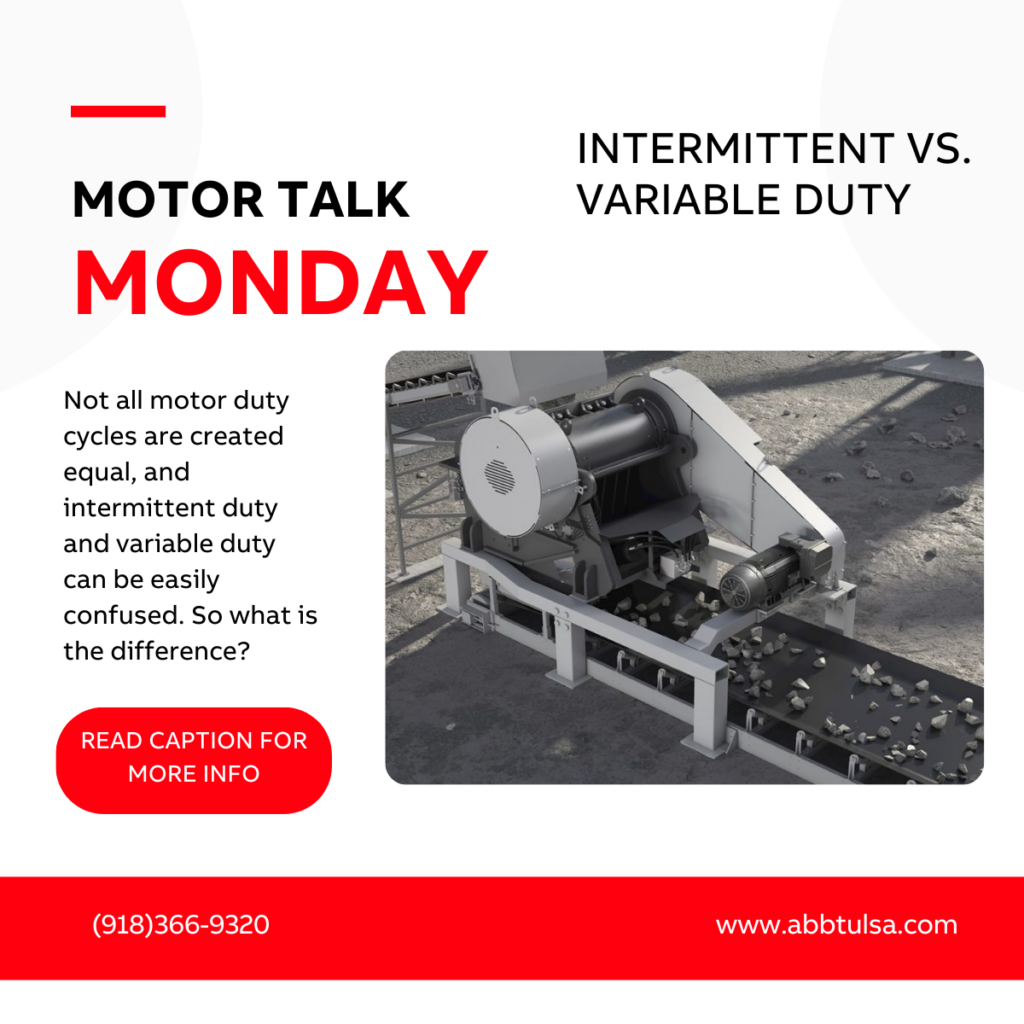
#MotorTalkMonday – intermittent vs. variable duty
Electric motor duty cycles play a critical role in thermal performance, reliability, and service life—especially in inverter-driven applications.
Intermittent duty motors (S2 or S3) are designed to operate at rated load for a limited time, followed by sufficient cooling periods. Because these motors never reach steady-state temperature, they can deliver higher short-term torque in smaller frame sizes. As a result, they work well in applications such as crane hoists, dam gates, and indexing presses.
Variable duty motors (S9 or S10), on the other hand, are built for frequent starts, speed changes, and load fluctuations, often with little or no cooling time between cycles. For this reason, they are commonly used in VFD-driven applications like conveyors, mill drives, and mining equipment, where continuous thermal cycling is expected.
Problems can arise when an intermittent-duty motor is applied in a variable-duty or continuous-cycle application. Over time, heat can build up faster than the motor can dissipate it. This leads to insulation stress, accelerated aging, and ultimately, premature motor failure.
Variable-duty motors are specifically engineered to handle these demanding conditions. They use enhanced insulation systems and optimized cooling designs to withstand frequent thermal changes without degradation.
Key takeaway:
Intermittent duty depends on predictable cooling. Variable duty assumes constant change. Selecting the correct duty rating is essential for long-term motor reliability.
Have questions about selecting the right motor for your duty cycle? Give us a call today, we’d love to chat about your needs.