#MotorTalkMonday – Meet the Rotor
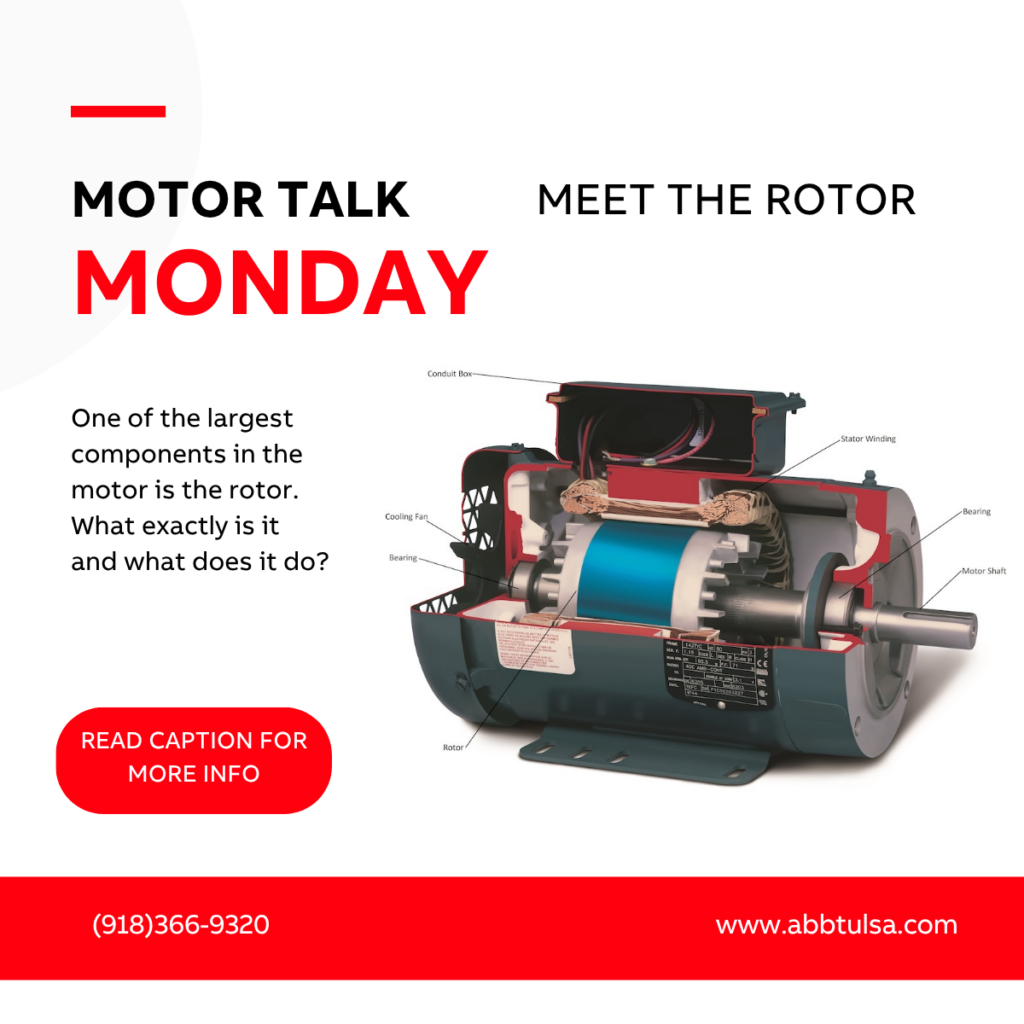
If you’ve ever looked at a cutaway of an electric motor, you’ve probably noticed the large cylindrical component in the center. That’s the rotor, and it’s responsible for turning electrical energy into mechanical motion.
The rotor’s job
The rotor is mounted directly to the motor shaft and rotates whenever the motor is running. However, it doesn’t receive electrical power directly in a standard induction motor.
Instead, electricity flows through the stator windings, creating a rotating magnetic field around the rotor. That magnetic field induces current in the rotor, producing the torque needed to rotate the shaft and power the connected equipment.
Why is the rotor important?
Without the rotor, the motor would still create a magnetic field, but there would be nothing to convert that energy into useful mechanical work. The rotor is what allows an induction motor to drive pumps, fans, conveyors, compressors, and countless other industrial applications.
The takeaway
The next time you see a motor cutaway, take a closer look at the rotor. It may seem like a simple cylinder, but it’s the component that transforms the stator’s rotating magnetic field into the mechanical motion that keeps your operation moving.