#MotorTalkMonday – 5 Motor Nameplate Values You Should Know
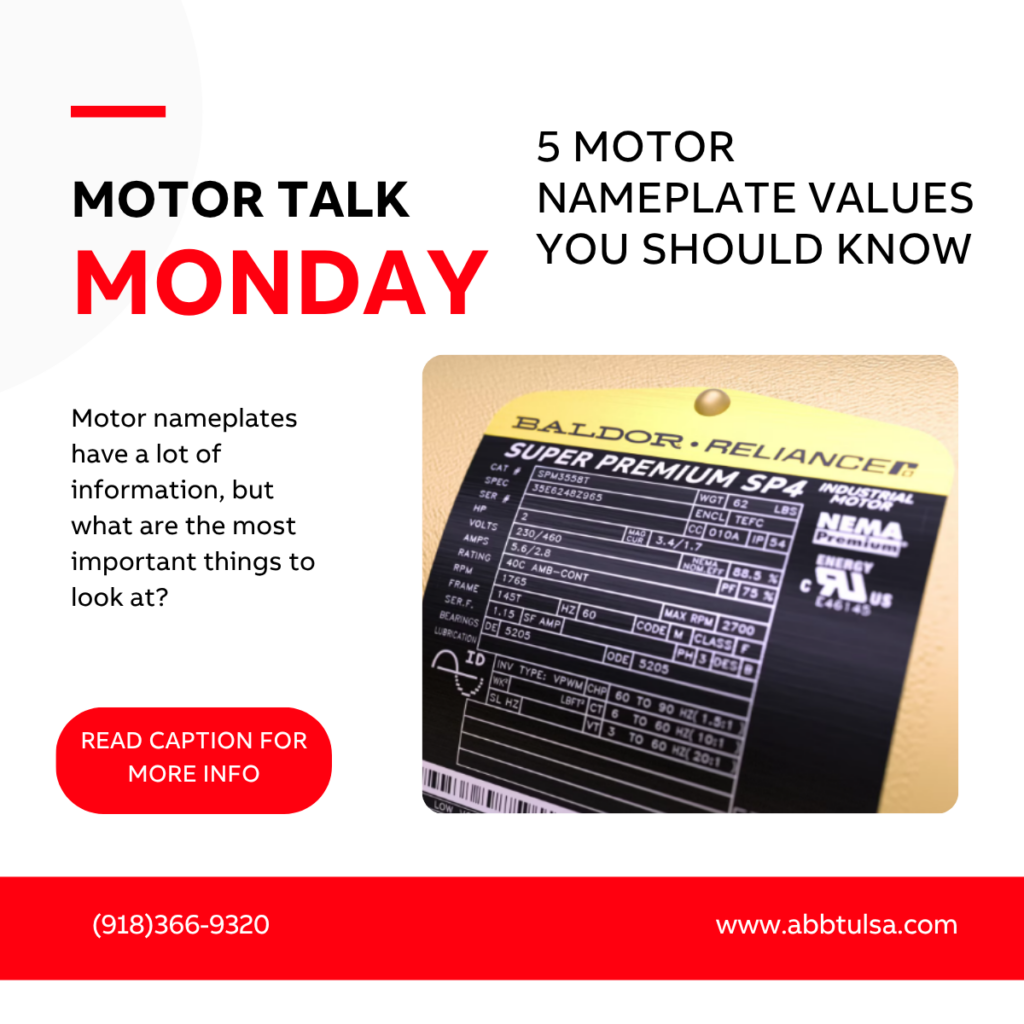
When troubleshooting a motor issue or selecting a replacement, one of the most valuable tools is often right in front of you: the motor nameplate.
A motor nameplate contains key operating information that helps users install, operate, and maintain motors correctly. While modern nameplates include many ratings and specifications, understanding a few core values can go a long way.
1. Horsepower (HP)
Horsepower is the motor’s rated mechanical output power. It indicates how much work the motor is designed to perform.
Choosing the correct horsepower is important. An undersized motor may overload, while an oversized motor can reduce efficiency in some applications.
2. Voltage
The voltage rating identifies the electrical supply the motor is designed to operate on.
Many industrial motors are dual-voltage rated, such as 230/460 volts. Proper connection and operation at the correct voltage are critical for reliable performance.
3. Full Load Amps (FLA)
Full Load Amps, or FLA, is the current the motor draws when operating at rated horsepower, rated voltage, and rated frequency.
FLA is commonly used when:
- Sizing overload protection
- Evaluating motor loading
- Troubleshooting electrical issues
- Verifying operating conditions
A motor drawing significantly more than its rated FLA may indicate a problem that requires further investigation.
4. Speed (RPM)
Motor speed is listed in revolutions per minute (RPM).
A common misconception is that a 1,800 RPM motor actually runs at exactly 1,800 RPM. In reality, induction motors operate slightly below synchronous speed because of slip.
For example, many four-pole motors have a nameplate speed of approximately 1,760 RPM.
5. Service Factor (SF)
Service factor represents the motor’s ability to handle occasional overload conditions under specified operating conditions.
For example, a 10 HP motor with a 1.15 service factor can support up to 11.5 HP under appropriate conditions.
However, service factor should not be viewed as additional continuous horsepower. Operating continuously in the service factor range may increase operating temperatures and reduce motor life.
Why Nameplate Information Matters
Understanding motor nameplate data can help with:
- Selecting replacement motors
- Diagnosing operating problems
- Verifying electrical conditions
- Improving reliability
- Preventing costly mistakes
The next time you encounter a motor issue, start with the nameplate. The information it provides can often point you in the right direction before more advanced troubleshooting begins.